
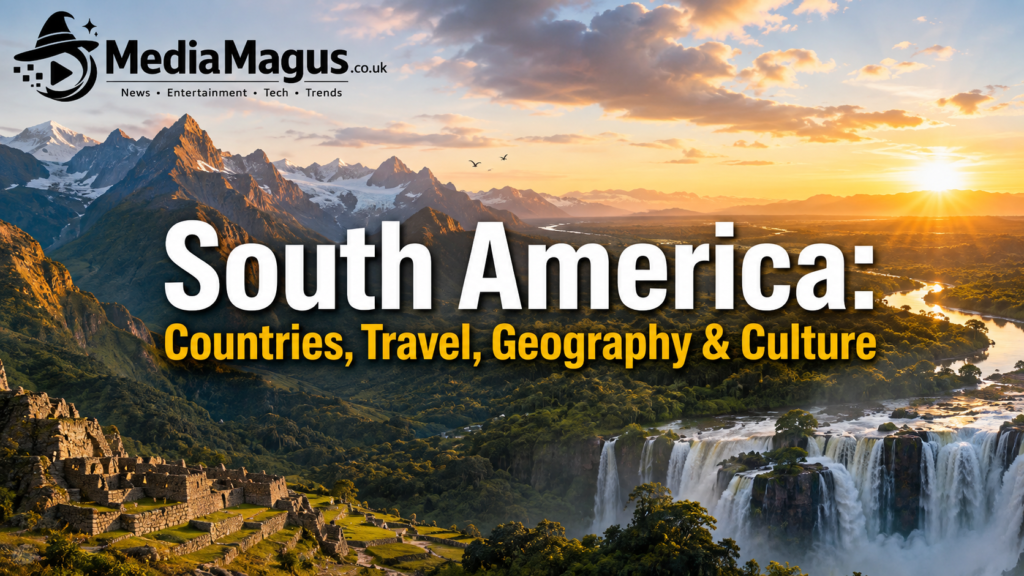

South America is a continent of remarkable contrasts. Within one region, travellers can move from the high peaks of the Andes to the tropical Amazon rainforest, from the dry landscapes of the Atacama Desert to the glaciers and mountains of Patagonia. The continent is also home to ancient civilizations, vibrant cities, Indigenous cultures, extraordinary wildlife, and some of the world’s most recognizable natural landmarks.
For travellers, students, geography enthusiasts, and anyone researching the continent, South America offers far more than a single destination. Its 12 independent countries each have their own identity, landscapes, traditions, foods, and travel experiences. National Geographic identifies 12 independent countries in South America, while territories such as French Guiana and the Falkland Islands are geographically part of the continent but are not independent countries.
What Is South America?
South America is the fourth largest continent by area and is located mainly in the Southern Hemisphere. It is bordered by the Pacific Ocean on the west and the Atlantic Ocean on the east, while the northern part connects with the broader landmass of the Americas. Its geography is unusually varied, with enormous mountain systems, river basins, forests, deserts, grasslands, coastlines, and southern wilderness.
One of the continent’s defining geographical features is the Andes Mountains, which extend along much of its western side. The Amazon Basin dominates a huge portion of the north and centre, while areas such as the Pampas of Argentina and Uruguay and Patagonia in the far south create completely different landscapes. This geographical variety is one reason South America can support such a wide range of climates, ecosystems, cultures, and travel experiences.
South America is also culturally diverse. Spanish is the dominant language across many countries, but Portuguese is the official language of Brazil, while Guyana and Suriname provide English and Dutch speaking traditions respectively. Indigenous languages, including Quechua, Aymara, and Guaraní, remain important in several countries.
Countries in South America
South America contains 12 sovereign countries:
| Country | Capital | Key Characteristic |
|---|---|---|
| Argentina | Buenos Aires | Patagonia, wine regions and cosmopolitan culture |
| Bolivia | Sucre / La Paz | Andes, high altitude landscapes and Uyuni |
| Brazil | Brasília | Amazon, beaches, cities and Portuguese culture |
| Chile | Santiago | Andes, Atacama Desert and long Pacific coastline |
| Colombia | Bogotá | Caribbean coast, coffee region and Andes |
| Ecuador | Quito | Andes, Pacific coast and Galápagos |
| Guyana | Georgetown | Rainforest and English speaking Caribbean influence |
| Paraguay | Asunción | Guaraní culture and inland landscapes |
| Peru | Lima | Inca heritage, Andes and Amazon |
| Suriname | Paramaribo | Dutch heritage and extensive rainforest |
| Uruguay | Montevideo | Beaches, relaxed coastal cities and countryside |
| Venezuela | Caracas | Caribbean coastline, mountains and Angel Falls |
The distinction between countries and territories is important when researching a South America map. French Guiana is an overseas department and region of France, while the Falkland Islands are a British Overseas Territory. Both are located in South America but are not sovereign South American states.
Bolivia is another interesting geographical and political case because Sucre is its constitutional capital while La Paz serves as the seat of government. These details make South America particularly interesting for students researching countries, capitals, and political geography.
Geography and Natural Features of South America
South America’s geography is one of its greatest strengths. The Andes form the continent’s dramatic western backbone, while the Amazon Basin creates an enormous lowland region in the north. Between these major systems are deserts, plains, plateaus, forests, wetlands, rivers, and coastal ecosystems.
The Amazon Rainforest is perhaps the continent’s most internationally recognized natural feature. The Amazon Basin contains an enormous concentration of plant and animal life, and National Geographic notes that more than 15,000 plant and animal species are found only within the Amazon Basin. The region also plays an important role in global environmental research and conservation.
The Andes Mountains create another defining landscape. Countries including Chile, Argentina, Bolivia, Peru, Ecuador, Colombia, and Venezuela contain major Andean landscapes. These mountains influence climate, agriculture, transport, settlement, and tourism throughout western South America.
Chile’s Atacama Desert provides an extraordinary contrast to the Amazon. It is one of the driest places on Earth and has landscapes that can resemble another planet. Farther south, Patagonia introduces dramatic mountains, lakes, forests, glaciers, and open plains across southern Argentina and Chile.
South America is also shaped by major rivers. The Amazon is particularly significant, and National Geographic describes it as the world’s largest river by volume of water. Venezuela’s Angel Falls adds another geographical superlative, with water dropping more than 979 metres.
Culture, Languages, and History
The culture of South America cannot be reduced to one national identity. Instead, the continent contains a mixture of Indigenous traditions, European influences, African heritage, Asian communities, and modern urban cultures.
Before European colonization, sophisticated Indigenous societies developed across the continent. The Inca civilization is particularly associated with the Andes, while numerous other Indigenous peoples developed their own languages, economies, traditions, and political systems. European colonization, particularly by Spain and Portugal, dramatically changed the continent’s political and cultural landscape.
Today, Spanish and Portuguese dominate much of South America, but the linguistic picture is considerably richer. Indigenous languages continue to be spoken in different regions. Quechua has a strong presence in parts of the Andes, while Guaraní has a particularly important cultural and linguistic role in Paraguay and neighbouring areas. Guyana’s English speaking heritage and Suriname’s Dutch speaking identity further distinguish northern South America.
Food is another important part of the continent’s identity. Argentine and Uruguayan cuisine is well known for grilled meats, Peru has gained international recognition for dishes such as ceviche, Brazil has its own rich culinary traditions, and Andean countries feature ingredients such as potatoes, maize, quinoa, and a wide variety of native crops.
Best Places to Visit in South America
South America is particularly attractive for travellers because different destinations provide completely different experiences. Rather than trying to see the entire continent in one trip, travellers usually get better results by choosing a region and building an itinerary around it.
Machu Picchu in Peru is one of the continent’s most famous archaeological destinations. The historic sanctuary sits at approximately 2,430 metres above sea level in a spectacular mountain environment. UNESCO describes it as an outstanding combination of cultural and natural value, connected to the Inca civilization and the surrounding Andes Amazon landscape.
Rio de Janeiro in Brazil appeals to travellers interested in beaches, urban culture, music, food, and dramatic scenery. The city combines a dense urban environment with mountains, coastline, and famous viewpoints.
Buenos Aires in Argentina offers a very different experience, with European influenced architecture, neighbourhood culture, cafés, museums, music, and Argentine culinary traditions. It is particularly suitable for travellers who want a major city experience before exploring Argentina’s wider landscapes.
Patagonia is a strong choice for hikers and outdoor travellers. Shared by Argentina and Chile, the region is known for mountains, glaciers, lakes, and enormous open landscapes. It is better suited to travellers who are comfortable with longer journeys and changing weather.
The Galápagos Islands in Ecuador are ideal for wildlife focused travel. UNESCO describes the islands as a unique living laboratory of evolution, with species including giant tortoises, land iguanas, and distinctive finches. The archipelago lies about 1,000 kilometres from mainland Ecuador.
Iguazú Falls, on the border of Argentina and Brazil, is another exceptional destination. The waterfall system stretches across almost three kilometres, with drops reaching around 80 metres. Both the Argentine and Brazilian sides offer different perspectives of the falls and surrounding rainforest.
Wildlife and Biodiversity
South America is one of the world’s most important regions for biodiversity. The Amazon alone supports a huge variety of plants, insects, birds, fish, reptiles, and mammals, while the Andes and other ecosystems provide habitats for species adapted to very different environments.
Travellers may encounter animals such as jaguars, giant anteaters, tapirs, monkeys, llamas, alpacas, spectacled bears, condors, caimans, and giant tortoises depending on the destination. The Galápagos is particularly famous for species that evolved in isolation, while the Amazon provides one of the world’s richest tropical ecosystems.
Wildlife tourism also comes with responsibility. Visitors should choose reputable operators, avoid buying products made from protected wildlife, respect park rules, and maintain appropriate distances from animals. Responsible tourism helps protect the ecosystems that make South America so exceptional.
Best Time to Visit South America
There is no single best month for visiting all of South America because the continent covers a huge geographical area and crosses different climate zones. A good travel season for Patagonia may not be ideal for the Amazon, while the preferred conditions for visiting the Andes can differ from those on the Brazilian coast.
Travellers heading to Patagonia generally plan around the warmer months of the Southern Hemisphere, while visitors to tropical regions need to consider rainfall as well as temperature. High altitude destinations such as Cusco and La Paz also require attention to elevation, regardless of the month.
For a first trip, it is more useful to choose the destination first and then research its seasonal conditions. This approach prevents a common travel mistake: planning an entire continent around one generic “best time to visit South America.”
South America Travel Tips
South America is enormous, so realistic itinerary planning matters. Trying to visit Brazil, Argentina, Peru, Chile, Colombia, and Ecuador during a short holiday can result in spending more time at airports and border crossings than actually experiencing the destinations.
Travellers should also research entry requirements, passport validity, travel insurance, local transport, and health recommendations before departure. Requirements can differ significantly between countries and may change, so official government and embassy sources should be checked close to the travel date.
Altitude deserves particular attention in destinations such as Cusco, La Paz, Quito, and other Andean locations. Travellers coming directly from low elevations may need time to adjust before undertaking strenuous activities.
Language preparation is equally useful. Spanish will be helpful in much of the continent, but Brazil operates primarily in Portuguese. Basic phrases, offline translation tools, and knowledge of local customs can make travel considerably easier.
For internal travel, distances should never be underestimated. South America looks manageable on a map, but major destinations can be separated by thousands of kilometres. A focused itinerary is usually more enjoyable than attempting to cover too much territory.
Conclusion
South America is best understood not as one destination but as a collection of remarkably different places connected by geography, history, culture, and shared regional influences. Its 12 independent countries range from the Portuguese speaking giant Brazil to the high Andes of Bolivia and Peru, the southern landscapes of Argentina and Chile, and the tropical ecosystems of Colombia, Ecuador, Guyana, Suriname, and Venezuela.
For travellers, the greatest advantage is choice. You can explore Inca history in Peru, wildlife in Ecuador, rainforest in Brazil, glaciers in Patagonia, deserts in Chile, or cultural life in Argentina and Colombia. For geography enthusiasts, South America provides an equally rich subject, combining some of the world’s most important mountains, rivers, forests, deserts, and biodiversity hotspots.
You may also explore more blogs
Frequently Asked Questions About South America
How many countries are in South America?
South America has 12 sovereign countries: Argentina, Bolivia, Brazil, Chile, Colombia, Ecuador, Guyana, Paraguay, Peru, Suriname, Uruguay, and Venezuela. French Guiana and the Falkland Islands are also located in the continent but are territories rather than independent South American countries.
What is South America best known for?
South America is best known for the Amazon Rainforest, Andes Mountains, diverse Indigenous cultures, football, vibrant cities, extraordinary wildlife, ancient sites such as Machu Picchu, and natural attractions including Iguazú Falls and the Galápagos Islands.
What languages are spoken in South America?
Spanish and Portuguese are the two most widely associated languages with South America. Spanish is official in most countries, while Portuguese is the official language of Brazil. English is official in Guyana and Dutch in Suriname. Many Indigenous languages also remain important
Is South America a good destination for tourists?
Yes. South America offers destinations for many travel styles, including adventure, wildlife, history, food, beaches, hiking, cultural tourism, and city breaks. The main challenge is choosing a realistic itinerary because the continent is very large.
What is the most famous place in South America?
Machu Picchu is among the continent’s most internationally famous landmarks. Other globally recognized attractions include the Amazon Rainforest, Iguazú Falls, the Galápagos Islands, Patagonia, and the Andes.
Which country in South America is best for first time visitors?
There is no universal answer. Peru is particularly attractive for history and archaeology, Brazil for beaches and major city experiences, Argentina for cities and Patagonia, Colombia for culture and diverse landscapes, and Ecuador for combining the Andes with the Galápagos
Is South America expensive to visit?
Travel costs vary substantially by country, destination, accommodation type, season, and transport choices. A traveller can often control costs by using local accommodation, public transport, regional flights selectively, and longer stays rather than attempting many countries in a short period.
Why is South America geographically diverse?
Its diversity comes from its enormous size and varied physical geography. The continent contains the Andes, Amazon Basin, deserts, tropical forests, grasslands, wetlands, coastal zones, and southern mountain environments. These landscapes create very different climates and ecosystems across relatively short geographical regions.