
Checking your engine oil is one of the simplest ways to monitor an important part of your car’s health. You do not need advanced mechanical knowledge to perform a basic oil level check, and in many vehicles the process takes only a few minutes.
If you are wondering how to check oil level in car, the basic method is to park on level ground, switch off the engine, allow the oil to settle, remove and wipe the dipstick, reinsert it fully, then remove it again and compare the oil level with the minimum and maximum marks. Always follow your vehicle manufacturer’s instructions because the exact checking procedure can vary between models.
Why Checking Engine Oil Matters
Engine oil lubricates moving internal components and helps protect them from wear. If the oil level becomes too low, parts of the engine may not receive adequate lubrication. Ford, for example, notes that insufficient lubrication can allow metal to metal contact that may cause serious engine damage.
Checking the level is therefore different from getting an oil change. A dipstick check tells you approximately how much oil is currently in the engine; it does not by itself tell you whether the oil is due for replacement.
A useful habit is to check the oil periodically and whenever you notice a warning light, an unusual smell, possible leakage, or other changes in engine behaviour.
When to Check the Oil Level
For a traditional dipstick, the car should generally be parked on a level surface with the engine switched off. The oil also needs time to drain back into the oil pan so that the measurement is meaningful.
Mobil recommends checking before starting the engine or waiting around 5–10 minutes after switching it off. Its general car care guidance also describes waiting several minutes before taking a reading.
However, your owner’s manual takes priority. Some engines have specific requirements concerning engine temperature and the waiting period. If your manual says to check the oil under a particular condition, use that procedure.
What You Need Before Checking
You normally need only:
- Your vehicle owner’s manual
- A clean cloth or paper towel
- The correct engine oil if topping up is necessary
- A funnel, if available, to reduce spills
The owner’s manual is particularly important because oil specifications and capacities differ between engines. Ford specifically advises owners to use the oil viscosity grade recommended in the owner’s guide.
How to Check Oil Level in Car
Park on a Level Surface
Park the vehicle on reasonably flat, stable ground and engage the parking brake. An incline can allow oil to move within the oil pan, potentially causing the dipstick to show a level that does not accurately represent the engine’s normal measurement.
Turn off the engine before opening the bonnet. If the engine has recently been running, allow sufficient time for the oil to settle according to the manufacturer’s instructions.
Turn Off the Engine and Let the Oil Settle
Engine oil circulates through the engine while it is running. Immediately after shutdown, some of that oil is still distributed throughout the engine rather than collected in the oil pan.
Wait for the period recommended by your vehicle manufacturer. As a general reference, Mobil recommends checking before starting the engine or after allowing several minutes for the oil to return to the pan.
Find and Remove the Dipstick
Open the bonnet and locate the engine oil dipstick. On many vehicles it has a coloured handle, although its exact appearance and location vary.
Do not assume every dipstick in the engine bay measures engine oil. Some vehicles have separate components associated with transmission fluid or other systems. If you are unsure, consult the owner’s manual.
Pull the engine oil dipstick completely out.
Wipe, Reinsert and Check the Dipstick
Wipe the dipstick clean with a lint free cloth or paper towel. Then insert it completely back into its tube.
Remove it again and hold it horizontally or in a position where you can clearly see the oil film.
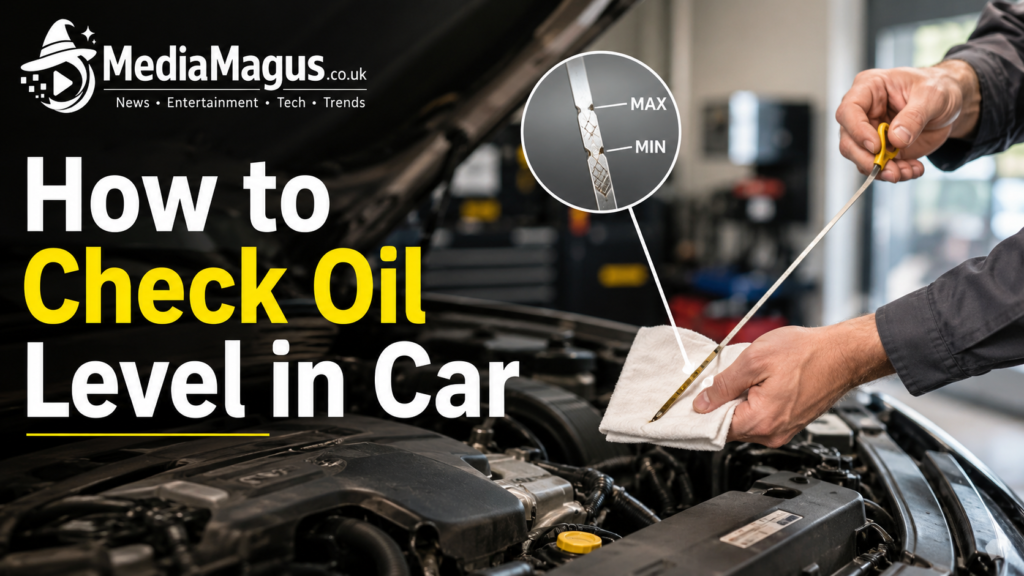
The dipstick normally has two reference marks, holes, lines, or areas indicating a lower and upper acceptable level. The exact markings vary by vehicle.
The oil should generally sit between the minimum and maximum indicators.
Read the Minimum and Maximum Marks
The important point is not simply whether oil appears on the dipstick. You need to see where the oil film reaches relative to the manufacturer’s markings.
| Dipstick reading | What it generally means |
|---|---|
| Below minimum | Oil may need to be added promptly |
| Between minimum and maximum | Generally within the indicated operating range |
| Near maximum | Usually an appropriate full reading |
| Above maximum | Possible overfill; investigate before continuing to add oil |
If the reading is below the minimum mark, do not automatically pour in a large amount. Check the owner’s manual for the correct procedure and recommended quantity.
Toyota also advises checking the level with the dipstick while adding oil and referring to the owner’s manual for the correct oil capacity.
What to Do If the Oil Level Is Low
Add the Correct Engine Oil
If the dipstick shows that the level is low, use an engine oil that meets the specification required for your particular vehicle.
Do not select oil based solely on what another car uses. Engine oil viscosity and performance specifications can differ significantly between engines.
Add a small amount at a time rather than filling the engine to an assumed capacity. This gives you better control and reduces the risk of overfilling.
After adding oil, replace the filler cap securely.
Recheck the Level
Give the oil time to settle before checking again. Mobil’s general guidance recommends waiting about 60 seconds after topping up before rechecking, while the exact procedure can vary by vehicle.
Remove, wipe, reinsert and read the dipstick again. Stop adding oil once the level reaches the appropriate range specified by the manufacturer.
How to Tell If the Oil Level Is Too High
An oil level above the maximum mark should not be treated as harmless simply because the engine has plenty of lubrication.
Too much oil can cause problems in some engines because moving components can interact with excess oil, potentially causing aeration and other issues. If you accidentally add significantly more oil than recommended, consult the owner’s manual or a qualified technician rather than continuing to drive without checking what should be done.
The safest approach is simple: do not intentionally fill above the manufacturer’s maximum level.
What the Oil on the Dipstick Can Tell You
The dipstick can provide more information than just the quantity of oil.
Fresh oil may appear relatively clear or amber depending on the oil and engine. As oil is used, it can become darker. Dark oil does not automatically mean the engine is damaged or that an oil change is immediately required because oil can darken as it performs its cleaning and lubrication functions.
However, unusual findings deserve attention. For example, a very unusual milky appearance, strong fuel smell, visible metal particles, or significant sludge may justify professional inspection.
The oil level itself is also important. If you repeatedly need to add oil between scheduled services, do not simply keep topping it up indefinitely. A mechanic should investigate possible leaks or excessive oil consumption.
Mobil notes that if an oil level drops from maximum to minimum in less than 1,000 miles (about 1,500 km), the engine should be checked.
Cars Without a Traditional Dipstick
Not every modern vehicle provides a conventional physical dipstick. Some cars use an electronic oil level measurement system and display the result through the instrument cluster or infotainment system.
If your vehicle does not have a dipstick, do not try to improvise a measurement. Follow the manufacturer’s electronic checking procedure.
This is another reason the owner’s manual matters: oil checking procedures can be model specific.
Common Mistakes to Avoid
Several simple mistakes can make an oil level check inaccurate:
- Checking the car while it is parked on a steep slope
- Taking a reading immediately after switching off the engine
- Failing to wipe the dipstick before the measurement
- Not fully reinserting the dipstick
- Using an oil that does not meet the manufacturer’s specification
- Adding a large quantity without rechecking
- Filling above the maximum mark
- Assuming dark oil automatically means the engine needs an immediate oil change
- Ignoring repeated oil level drops
- Continuing to drive after a serious oil pressure warning without consulting the vehicle instructions
A five minute check is useful only when the reading is taken correctly.
When Low Oil Means You Need a Mechanic
A low reading does not always mean the engine simply needs more oil.
If the level repeatedly falls after topping up, look for signs of an oil leak around the engine and underneath the vehicle. Persistent oil consumption can also have internal causes that require professional diagnosis.
You should seek professional assistance if you notice significant oil leakage, unusual engine noise, smoke, a persistent oil pressure warning, or an oil level that changes unexpectedly.
Do not confuse an oil level warning with a routine reminder to schedule an oil change. Warning systems differ between vehicles, so consult the owner’s manual when a dashboard warning appears.
Conclusion
Learning how to check oil level in car is a valuable basic maintenance skill. The process is straightforward: park safely on level ground, follow the manufacturer’s temperature and waiting instructions, check the dipstick correctly, compare the reading with the marked range, and add only the specified oil when necessary.
The most important habit is not simply checking whether oil is present, but watching for changes over time. A consistently low reading, repeated top ups, visible leaks, unusual oil appearance, or dashboard warnings can indicate a problem that requires professional attention. Regular oil checks combined with the manufacturer’s maintenance schedule can help you catch potential issues before they become expensive engine repairs.
You may also explore more blogs
Frequently Asked Questions
Should I check engine oil when the car is hot or cold?
The correct procedure depends on the vehicle. Many traditional dipstick checks can be performed before starting the engine or after allowing the engine to sit for several minutes. Mobil recommends checking before startup or around 5–10 minutes after shutdown, but your owner’s manual should take priority.
How often should I check my car’s oil level?
There is no single interval that applies to every vehicle. Checking periodically, especially before long journeys and when monitoring an older or higher mileage vehicle, can help you identify low oil earlier. Follow your manufacturer’s maintenance guidance.
Should the oil level be at minimum or maximum?
If the manufacturer’s dipstick shows a minimum and maximum range, the oil should normally be within that range. Do not deliberately exceed the maximum mark.
Can I check engine oil immediately after driving?
You can check it after driving only if your vehicle’s procedure permits it and you allow the recommended settling time. Checking immediately after shutdown may give an inaccurate reading because oil is still circulating through the engine
What happens if the oil level is below the minimum mark?
Add the correct oil according to your vehicle manufacturer’s instructions and recheck the level. If the level keeps dropping, have the vehicle inspected for leaks or excessive oil consumption.
Is dark engine oil always bad?
No. Engine oil naturally becomes darker during use. Colour alone is not a reliable way to determine whether oil needs changing. Consider the vehicle’s maintenance schedule and any unusual signs such as contamination, sludge, or abnormal smells
Can I use any engine oil for topping up?
No. Use oil that meets the specification and viscosity recommended for your particular engine. Check the owner’s manual or manufacturer’s approved specifications before adding oil.
Why does my car keep losing engine oil?
Repeated oil loss can result from an external leak, oil consumption inside the engine, or another mechanical issue. If you frequently need to top up the oil, the underlying cause should be investigated rather than ignored.