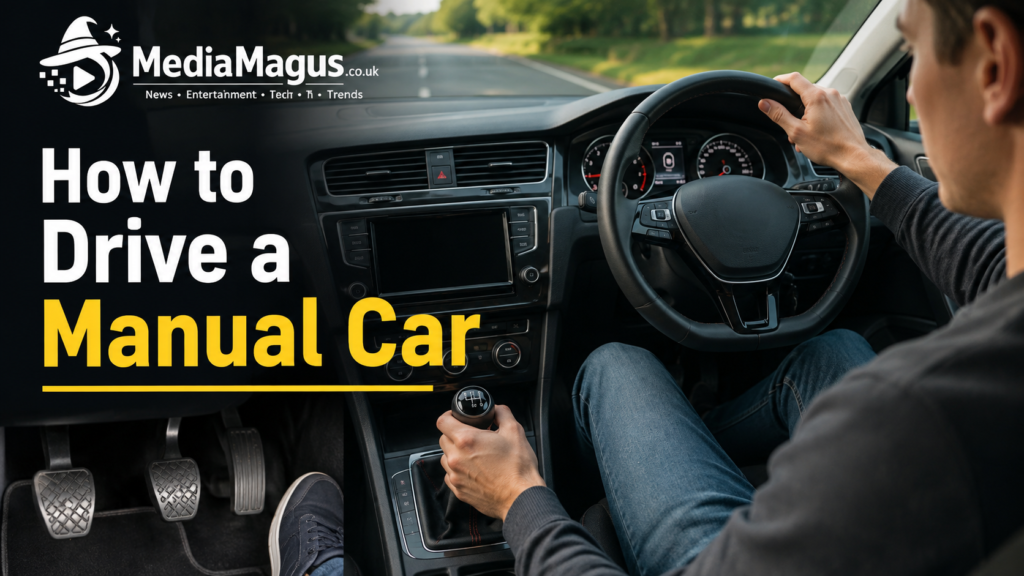

Learning how to drive a manual car can feel difficult during the first few lessons because your left foot, right foot, hands, eyes, and attention all have to work together. Unlike an automatic vehicle, a manual car requires you to operate a clutch pedal and select gears yourself. The good news is that manual driving becomes much easier once you understand the relationship between the engine, clutch, accelerator, and gearbox. The most important skill for a beginner is not changing gears quickly but learning smooth clutch control. Once you can consistently find the clutch’s biting point and move away without stalling, the rest of manual driving becomes considerably more manageable. Always learn in a safe, legal environment with a qualified instructor where possible, and follow the rules and requirements that apply in your country.
What Is a Manual Car?
A manual car is a vehicle in which the driver selects the appropriate gear using a gear lever and operates the clutch pedal to temporarily disconnect the engine from the transmission during gear changes. Most conventional manual cars have three pedals: the clutch on the left, brake in the middle, and accelerator on the right. The gear lever normally provides several forward gears, reverse, and neutral. Lower gears provide stronger acceleration and are generally used when starting or travelling slowly, while higher gears are normally used as the vehicle gains speed. The exact gear arrangement varies between vehicles, so you should always become familiar with the particular car before driving it.
The clutch is one of the most important components for a new manual driver to understand. When the clutch pedal is fully pressed, the engine and gearbox are temporarily separated, allowing you to select a different gear. As you gradually release the clutch, the engine begins transferring power to the wheels. There is a point where the clutch starts engaging, commonly called the biting point or engagement point. Learning where this point is in your particular car is fundamental to smooth starts.
How the Clutch and Gears Work
Manual driving becomes easier when you stop thinking of the clutch as simply a pedal that must be pushed and released and instead understand its purpose. When you press the clutch completely, you can select a gear without the engine driving the wheels through the transmission. When you release it, power is progressively transferred to the drivetrain. If you release the clutch too quickly while the car is stationary, the engine may not have enough momentum to keep running and the vehicle can stall.
The gears determine how the engine’s power is delivered. First gear is designed primarily for getting the vehicle moving from a standstill, while second and third gears are useful as speed increases. Higher gears can be more efficient during steady driving, but the appropriate gear depends on the vehicle, road conditions, speed, engine characteristics, and traffic situation. Modern cars may have different gear ratios and recommended shift points, so the vehicle handbook is a better reference than relying on one universal speed for every gear.
How to Prepare Before Driving
Before starting the engine, adjust the driver’s seat so you can fully press the clutch pedal without stretching your leg and still maintain comfortable control of the brake and accelerator. Set the mirrors so you have a clear view around the vehicle, fasten your seat belt, and make sure you understand the location and pattern of the gear lever. With the car stationary, check that the handbrake is engaged and the gearbox is in neutral. These simple checks help prevent an unexpected movement when the engine starts.
Your first practice should take place somewhere appropriate and away from unnecessary traffic. A quiet, legal practice area can allow you to concentrate on clutch control rather than worrying about other road users. Keep both hands available for steering when appropriate and avoid looking down at the gear lever while the vehicle is moving. You should learn the gear pattern while stationary so that selecting gears becomes a controlled movement rather than something requiring visual attention.
How to Start and Move a Manual Car
To move away smoothly, start with the vehicle secure and the gearbox in neutral. Press the clutch fully before selecting first gear. Check your surroundings carefully, release the handbrake when appropriate, and begin to raise the clutch pedal slowly. As the clutch approaches its biting point, the car may begin to feel as though it wants to move. At this stage, apply a small amount of accelerator while continuing to release the clutch progressively. The precise amount of accelerator required varies between vehicles, so avoid concentrating on a particular engine revolution figure as a universal rule.
If the engine stalls, do not panic. A stall is a common part of learning manual driving. Secure the car, press the clutch, return to the appropriate starting procedure, and try again with slower clutch release and better coordination. The objective is to develop a feel for the vehicle rather than simply memorising a sequence of pedal movements. With practice, your feet will begin to recognise the engagement point naturally.
How to Change Gears Smoothly
Once the car is moving, you will eventually need to change into a higher gear. The basic process involves reducing or managing acceleration, pressing the clutch fully, selecting the next appropriate gear, and releasing the clutch smoothly while returning to the accelerator. The movement should be deliberate but not unnecessarily slow. If you hold the clutch down for too long or release it abruptly, the vehicle may respond less smoothly.
Downshifting requires similar coordination but serves a different purpose. You may need a lower gear when the vehicle slows, when you require additional engine response, or when road conditions make the lower gear more appropriate. Avoid selecting a gear that would cause the engine to operate at an excessively high speed. Similarly, do not force the car to remain in a high gear when its speed has dropped too far. Listening to the engine, feeling the vehicle’s response, and understanding the road ahead will gradually help you choose gears more naturally.
| Situation | Typical Gear Approach | Main Skill |
|---|---|---|
| Moving from a standstill | First gear | Clutch control |
| Slow moving traffic | Low gear as appropriate | Smooth pedal coordination |
| Increasing speed | Progressively higher gear | Timely shifting |
| Slowing significantly | Lower appropriate gear | Controlled downshifting |
| Waiting while stationary | Neutral may be appropriate | Reducing unnecessary clutch use |
| Reversing | Reverse gear | Very low speed control |
How to Stop a Manual Car
For a normal stop, reduce your speed using the brake while monitoring the road and traffic around you. As the vehicle slows toward the point where the selected gear is no longer suitable, press the clutch fully to prevent the engine from stalling. You can then select neutral if you are going to remain stationary for a meaningful period. At a very brief stop, the correct technique can depend on the vehicle, traffic conditions, and local driving guidance, but you should avoid unnecessarily holding the clutch down for extended periods.
When parking, make sure the vehicle is securely stopped, apply the handbrake, and follow the manufacturer’s guidance regarding gear selection for parking. On a slope, additional care is necessary because gravity can cause the vehicle to move if it is not properly secured. Never assume that leaving the vehicle in gear alone replaces the need for the parking brake.
How to Drive on Hills
Hill starts are one of the most challenging skills for beginners because the vehicle naturally wants to roll backwards when the brakes are released. A common controlled method is to use the handbrake while finding the clutch’s biting point. With the car secure, select first gear, gradually bring the clutch to the engagement point, and apply suitable accelerator input. Once you are ready to move forward, release the handbrake smoothly while continuing to coordinate the clutch and accelerator.
Do not rely on excessive engine revving to solve every hill start. Excessive acceleration can make the vehicle move abruptly and can contribute to unnecessary clutch wear. The exact technique differs between vehicles, particularly those equipped with hill start assist or electronic parking brakes, so understand how the specific car operates before practising on a busy or steep road.
How to Reverse a Manual Car
Reversing requires patience because the vehicle should normally be controlled at very low speed. Select reverse according to the vehicle’s gear pattern and use the clutch carefully to regulate movement. Depending on the car and conditions, you may need little or no accelerator on level ground because the engine can provide enough power at idle. Keep the speed slow enough that you can stop immediately if necessary.
Good observation is more important than simply controlling the pedals. Check mirrors and blind spots, look around the vehicle as appropriate, and remain aware that pedestrians, children, cyclists, or obstacles can enter the reversing path. Never assume the area behind the vehicle is clear simply because it looked clear a moment earlier. Reversing cameras and sensors can assist, but they should supplement not replace direct observation.
Common Manual Driving Mistakes
Beginners often make similar mistakes while learning. One of the most common is riding the clutch, which means keeping the clutch partially engaged when it is unnecessary. This can increase clutch wear. Another mistake is releasing the clutch too quickly, which can cause jerky movement or stalling. Some new drivers also use excessive accelerator input because they are afraid of stalling, but smoother coordination is generally more useful than simply increasing engine speed.
Another common problem is choosing a gear that does not suit the vehicle’s speed or road conditions. Rather than memorising rigid shift speeds, learn to recognise how the car feels and responds. If the engine sounds strained, the vehicle struggles to accelerate, or the selected gear feels inappropriate, reassess the gear choice while maintaining safe control. Avoid resting your hand continuously on the gear lever because unnecessary pressure can contribute to mechanical wear in some transmission designs.
Tips for Becoming Confident
The fastest way to become comfortable with a manual car is consistent, controlled practice. Start by practising clutch engagement in a safe environment before attempting complicated traffic situations. Once you can move away smoothly, practise first to second and second to third gear changes, then work on slowing down and selecting lower gears. After that, practise stops, hill starts, reversing, parking, and driving in normal traffic under appropriate supervision.
Do not judge progress by how quickly you can change gears. Good manual driving is about smoothness, anticipation, mechanical sympathy, and maintaining control. A confident driver looks ahead, anticipates traffic, chooses an appropriate gear before a situation becomes difficult, and avoids unnecessary movements. With enough practice, clutch control and gear selection become increasingly automatic, allowing more attention to be devoted to road positioning, hazards, pedestrians, and other road users.
Conclusion
Learning how to drive a manual car is mainly a process of developing coordination and mechanical awareness rather than memorising complicated rules. The clutch biting point is the foundation: once you can move away smoothly, select appropriate gears, slow down without stalling, and control the vehicle on hills, manual driving becomes much less intimidating. Practise gradually, avoid rushing into difficult traffic situations, and learn the specific characteristics of the car you are driving. Most importantly, prioritise safe observation and vehicle control over speed. With patient practice and proper instruction, the movements that initially feel complicated can eventually become natural and consistent.
You may also explore more blogs
Frequently Asked Questions
Is driving a manual car difficult for beginners?
Manual driving can feel difficult initially because it requires coordination between the clutch, accelerator, brake, gear lever, and steering. The most challenging early skill is usually finding and controlling the clutch biting point. Regular practice in a safe environment makes these movements progressively more natural.
How do I stop a manual car without stalling?
Brake smoothly and monitor your speed. As the vehicle slows enough that the selected gear is no longer appropriate, press the clutch fully before the engine begins to struggle. For a longer stop, selecting neutral can allow you to release the clutch while remaining stationary.
What is the hardest part of learning manual driving?
For many beginners, moving away smoothly is the hardest part because clutch release and accelerator input must be coordinated. Hill starts can be another challenge because the driver must control the vehicle while preventing it from rolling backwards.
Can a manual car move without using the accelerator?
Some manual cars can begin moving at idle in suitable conditions, particularly on level ground, but this varies considerably by vehicle. Beginners should focus on controlled clutch operation rather than assuming that one technique works for every car.
When should I change gears?
You should change gears according to the vehicle’s speed, engine response, road conditions, traffic, and manufacturer’s guidance. There is no single universal shift speed that is correct for every manual car.
Is it bad to keep the clutch pressed at traffic lights?
Holding the clutch down for short periods may be necessary in some situations, but keeping it depressed unnecessarily for extended periods can increase wear on clutch release components. When appropriate and safe, selecting neutral and releasing the clutch during a longer stationary wait can reduce unnecessary clutch use.
How can I avoid stalling a manual car?
Learn the clutch biting point and release the clutch progressively while applying appropriate accelerator input. If the vehicle begins to shudder or the engine speed falls significantly, respond calmly and adjust the clutch and accelerator rather than releasing the clutch abruptly.
Is manual driving better than automatic driving?
Neither transmission is universally better. Manual cars give drivers direct control over gear selection and can be enjoyable for people who prefer that involvement, while automatic cars generally require less pedal coordination and can be easier in stopstart traffic. The best choice depends on the driver’s needs, vehicle, and local conditions.