
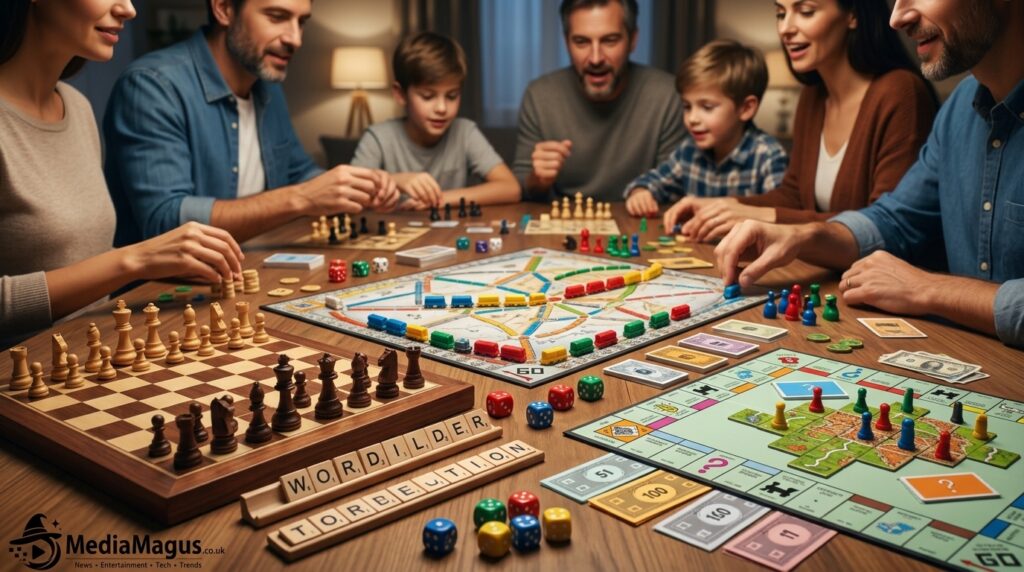

Board games continue to be one of the easiest ways for friends and families to spend quality time together without relying on phones, computers, or gaming consoles. Although digital entertainment has become a major part of everyday life, board games remain popular because they offer something different face to face interaction, competition, cooperation, conversation, and memorable moments around the same table. The phrase board games that are popular can refer to classic games that have been played for generations as well as modern tabletop titles that have introduced millions of people to new styles of gaming. Games such as Monopoly, Chess, Checkers, Scrabble, Catan, Ticket to Ride, Pandemic, Codenames, Risk, Clue, and Carcassonne continue to attract players for different reasons. Recent survey data also shows how strong the classic category remains. A 2026 YouGov survey found that Monopoly was the most widely played game among the titles it asked about, with Checkers, Scrabble, Connect Four, and Yahtzee also showing substantial familiarity among Americans.
Why Are Board Games Still So Popular?
The popularity of board games comes from their ability to combine entertainment with social interaction. Unlike many digital games where players may communicate through headsets or messages, traditional board games place everyone physically around the same table. This creates opportunities for conversation, laughter, friendly arguments, strategic thinking, and competition. Board games are also extremely flexible because there are games for almost every age group and personality. Someone who enjoys word challenges can choose Scrabble, a player who prefers strategy can try Chess or Catan, while someone looking for a mystery experience can choose Clue. Cooperative games such as Pandemic provide another option because players work together rather than competing directly against one another. The revival of board gaming has also been linked to the development of accessible modern games that are easier to learn and designed around social experiences.
Monopoly
Monopoly is arguably one of the most recognizable board games in the world and remains an excellent example of a classic game that has maintained its popularity for decades. Players move around a board, purchase properties, collect rent, and attempt to make strategic decisions that leave their opponents financially struggling. Part of Monopoly’s appeal comes from its combination of luck and decision making. The dice determine movement, but players still have choices about which properties to buy, trade, develop, or mortgage. The game can also create dramatic moments because a player who appears to be losing can sometimes recover through a successful trade or fortunate roll. According to recent YouGov research, 53% of Americans surveyed said they had played Monopoly many times, while only 5% said they had never played it, demonstrating just how deeply established the game is in popular culture.
Chess
Chess is another timeless example when discussing board games that are popular. Unlike games based heavily on luck, Chess is primarily about strategy, planning, pattern recognition, and anticipating an opponent’s moves. Each player controls sixteen pieces, including the king, queen, rooks, bishops, knights, and pawns, with different movement abilities. The objective is to place the opponent’s king in checkmate. Chess is popular among children, adults, casual players, and serious competitors because it can be enjoyed at almost any skill level. Beginners can learn the basic rules relatively quickly, while advanced players can spend years studying openings, tactics, endgames, and strategic concepts. Its simplicity of equipment combined with enormous strategic depth has helped Chess remain relevant across generations.
Checkers
Checkers may look simpler than Chess, but its accessibility is one of the reasons it remains popular. The basic rules can be learned quickly, making it particularly suitable for children and casual players. Players move pieces diagonally across the board and attempt to capture their opponent’s pieces while reaching the opposite side to create kings. Checkers is inexpensive, easy to set up, and does not require players to memorize complicated instructions. Recent survey data continues to place Checkers among the most widely played board games, with 46% of Americans in YouGov’s survey saying they had played it many times.
Scrabble
For people who enjoy words and language, Scrabble is one of the most popular board games available. Players use letter tiles to create words on a crossword style board while trying to earn as many points as possible. The game combines vocabulary, spelling, strategic positioning, and sometimes a little luck because players do not know which letters they will draw. Scrabble can be played casually with family members or competitively by people who enjoy maximizing scores and studying word combinations. Its educational value is another reason parents and teachers have used it as a fun way to encourage vocabulary development. YouGov’s recent survey found that Scrabble was among the classic games that large numbers of Americans had played many times.
Catan
Catan, originally known as The Settlers of Catan, represents the modern board game revolution and is one of the most important titles for people exploring contemporary tabletop gaming. Players compete to establish settlements, collect resources, build roads, and expand their influence across an island. One of the game’s most interesting features is trading, because players can negotiate with one another to obtain resources they need. This creates social interaction that is different from traditional roll and move games. Catan has often been described as a gateway game because it can introduce newcomers to deeper strategy without overwhelming them with extremely complicated rules. Its popularity has helped demonstrate that board games can offer sophisticated strategy while remaining accessible to casual players.
Ticket to Ride
Ticket to Ride is another highly popular modern board game and a strong choice for families, friends, and beginners who want something more strategic than classic games. Players collect colored train cards and use them to claim railway routes between cities. The objective is generally to complete destination routes and earn points while managing limited opportunities on the map. The rules are relatively straightforward, but players quickly discover that choosing which routes to claim can become a serious strategic decision. Ticket to Ride is also widely recognized as part of the modern board game renaissance. By 2024, the game and its versions had reached approximately 18 million copies sold worldwide, according to reported sales figures.
Codenames
Codenames is particularly popular among groups because it focuses on communication and word association rather than traditional board movement. Players are divided into teams, and a clue giver attempts to help teammates identify their team’s words from a grid of cards. The challenge is creating clues that are specific enough to guide teammates but broad enough to connect multiple target words. The game can produce hilarious misunderstandings as players interpret the same clue in completely different ways. It is also relatively easy to teach, making it a strong option for parties, family gatherings, and casual game nights. The growth of cooperative and social board games has helped titles such as Codenames attract people who may not traditionally consider themselves board game enthusiasts.
Pandemic
Pandemic offers a very different experience because players work together against the game rather than directly competing with each other. Each participant takes on a specialized role and works with the rest of the team to contain outbreaks and discover cures for diseases spreading around the world. Cooperation is essential because individual players cannot normally solve the entire problem alone. Every decision can affect the entire team, creating tension and encouraging discussion. Pandemic became one of the notable modern cooperative board games and has been repeatedly mentioned alongside Catan, Ticket to Ride, and Carcassonne as an influential title in the modern tabletop gaming movement.
Risk
Risk is a classic strategy board game centered on territory, armies, alliances, and global conquest. Players attempt to control territories and expand their influence while defending their own positions. The game can produce constantly changing alliances because players must decide when to attack and when to negotiate. Risk is particularly attractive to people who enjoy longer games and strategic planning. However, its length means it may not be the ideal choice for someone looking for a quick twenty minute game. For groups that enjoy competitive strategy and dramatic changes in the balance of power, however, Risk can provide an entertaining experience.
Clue
Clue, also known as Cluedo in some markets, is one of the most recognizable mystery board games. Players investigate a fictional murder and attempt to determine the suspect, location, and weapon involved. Instead of simply racing around a board, players gather information and use deduction to eliminate possibilities. This makes Clue particularly appealing to people who enjoy mysteries, puzzles, and detective stories. The game’s straightforward concept allows new players to understand the basic objective quickly, while the process of remembering information and making deductions gives it more depth than a simple luck based game.
Carcassonne
Carcassonne is another influential modern board game that has remained popular among tabletop enthusiasts. Players gradually build a medieval landscape using tiles featuring roads, cities, fields, and other features. Players then place their followers strategically to score points from completed areas. What makes Carcassonne interesting is that the board changes throughout the game because players construct it as they play. This gives every session a different layout and creates opportunities for tactical decisions. Carcassonne is also commonly recognized as one of the modern games that helped expand the board game hobby beyond traditional mass market titles.
Connect Four
Connect Four is a simple and fast game that works especially well for children and families. Two players take turns dropping colored discs into a vertical grid, attempting to connect four of their own pieces horizontally, vertically, or diagonally. The rules can be explained in seconds, but the game still requires players to look ahead and anticipate their opponent’s strategy. Its short playing time also makes it easy to play multiple rounds. Recent YouGov research found Connect Four among the classic board games that many Americans have played repeatedly.
Yahtzee
Yahtzee combines dice rolling with strategic decision making and is another familiar household game. Players roll five dice and attempt to achieve specific combinations, choosing which dice to keep and which to roll again. Although luck plays a significant role, players must make decisions about which scoring categories to pursue. The simple structure makes Yahtzee accessible to children and adults, while the scoring system creates enough strategy to encourage replayability. It remains one of the recognizable classic tabletop games and continues to appear among games with high levels of public familiarity.
Popular Board Games for Families
Families have a particularly wide range of options when looking for popular board games. Monopoly, Scrabble, Connect Four, Checkers, Clue, and Yahtzee are strong choices because their basic rules are easy to understand and multiple generations can enjoy them together. Modern games such as Ticket to Ride and Codenames can also work well for families with older children and teenagers. The best choice depends on the group’s age, attention span, and preferred playing style. For younger children, short games with simple rules are usually better, while older players may appreciate games involving negotiation, deduction, or strategy. A good family board game should encourage interaction without making the rules so complicated that beginners become frustrated.
Popular Board Games for Adults
Adults have access to an enormous selection of board games, ranging from quick party games to long strategy experiences. Catan is a popular choice for groups that enjoy trading and competition, while Codenames is excellent for social gatherings. Ticket to Ride offers an accessible combination of strategy and competition, whereas Risk provides a longer and more intense strategic experience. Players interested in deeper tabletop gaming can also explore games such as Wingspan, Terraforming Mars, Azul, and 7 Wonders. Modern board gaming has expanded considerably beyond traditional games, meaning adults can now choose experiences based on strategy, cooperation, storytelling, deduction, economics, fantasy, science fiction, or even political negotiation.
Popular Board Games for Game Night
A successful game night does not necessarily require the most complicated or expensive board game. In fact, games that are easy to explain and encourage conversation often work best. Codenames is a strong party option because players can form teams and communicate throughout the game. Ticket to Ride works well for groups wanting moderate strategy without an extremely long learning process. Monopoly can provide a nostalgic experience for families and friends, while Catan is suitable for groups looking for negotiation and resource management. The key is choosing a game that matches the number of players and the amount of time available.
How to Choose a Popular Board Game
Choosing between popular board games depends on several factors. First, consider the number of players because some games are designed primarily for two people while others work best with larger groups. Second, think about playing time. A quick game such as Connect Four is very different from a long Risk session. Third, consider complexity. Beginners may prefer Ticket to Ride, Codenames, or a classic game such as Clue, while experienced players may want more complicated strategy games. Finally, think about the atmosphere you want. Competitive games create tension, cooperative games encourage teamwork, and party games often prioritize humor and conversation. Popularity alone does not mean a game is right for everyone, so matching the game with the group is more important than simply choosing the most famous title.
Why Classic and Modern Board Games Both Matter
One of the most interesting aspects of the board game world is that classic and modern games continue to exist alongside each other. Monopoly, Chess, Checkers, and Scrabble remain familiar to huge numbers of people, while Catan, Ticket to Ride, Pandemic, Codenames, and Carcassonne have helped introduce new audiences to modern tabletop gaming. Research on board game popularity shows that many of the games played most frequently are decades old, while modern titles remain influential within the dedicated hobby. This means there is no single definition of the “best” board game. For one person, the perfect game may be a childhood classic; for another, it may be a modern strategy title discovered at a board game café.
Final Thoughts
The world of board games that are popular is much larger than a simple list of famous titles. Classic games such as Monopoly, Chess, Checkers, and Scrabble have survived because they are easy to recognize, relatively accessible, and capable of bringing people together. Modern games such as Catan, Ticket to Ride, Pandemic, Codenames, and Carcassonne have expanded the hobby by introducing deeper strategy, cooperation, negotiation, deduction, and creative gameplay. Whether you are planning a family evening, looking for entertainment with friends, or beginning to explore modern tabletop gaming, there is a board game suited to almost every group. The best approach is to consider the players, preferred style, available time, and desired level of complexity. With so many choices available, board games remain an entertaining way to disconnect from screens and spend meaningful time with other people.
You may also read more blogs
Frequently Asked Questions About Popular Board Games
What are the most popular board games?
Some of the most recognizable and widely played board games include Monopoly, Chess, Checkers, Scrabble, Clue, Risk, Yahtzee, Connect Four, Catan, Ticket to Ride, Pandemic, Codenames, and Carcassonne. Popularity can be measured in different ways, including sales, number of players, public familiarity, and hobby community interest.
What is the most popular board game?
Monopoly is one of the strongest candidates when popularity is measured by broad public familiarity and play. Recent YouGov research placed Monopoly ahead of several other classic and modern titles in terms of how many Americans reported having played it many times.
What are the best board games for families?
Monopoly, Scrabble, Checkers, Connect Four, Clue, and Yahtzee are excellent family friendly options. Families with older children can also consider Catan, Ticket to Ride, and Codenames.
What are the best modern board games?
Catan, Ticket to Ride, Pandemic, Codenames, Carcassonne, Azul, Wingspan, and Terraforming Mars are among the well known modern tabletop games. The right choice depends on whether you prefer competition, cooperation, strategy, wordplay, or resource management.
Are board games still popular?
Yes. Board games remain widely played, particularly classic titles, while modern tabletop gaming has developed a large and active hobby community. Recent research and surveys continue to show strong participation in board games, demonstrating that physical tabletop gaming remains relevant despite the growth of digital entertainment.