
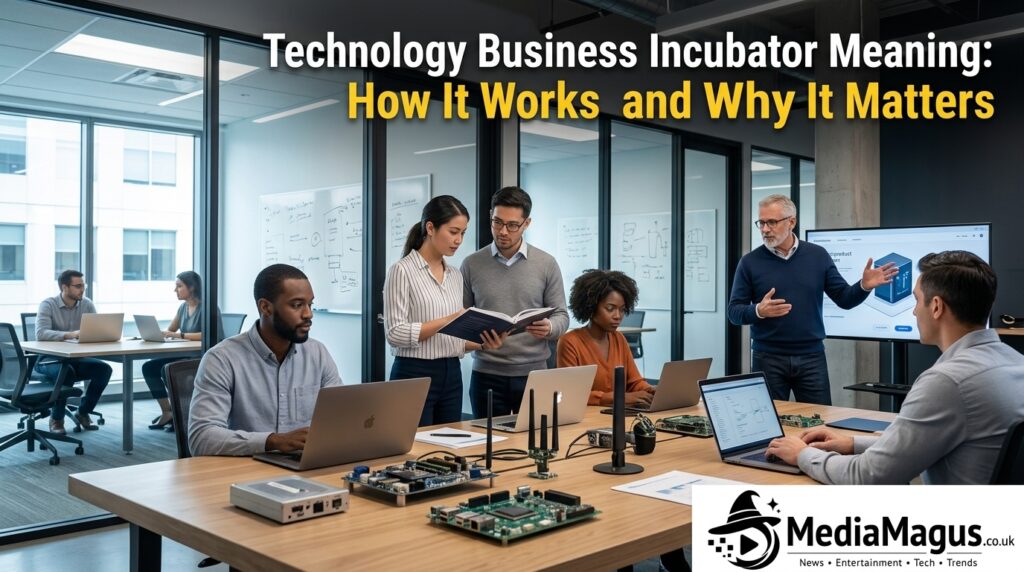

A technology business incubator (TBI) is an organisation or structured programme that helps early stage, technology focused businesses develop, commercialise their ideas and become sustainable companies. Unlike a general business incubator, a technology business incubator typically places greater emphasis on innovation, research, technology development, technical infrastructure and the commercialisation of new products or services. Support can include workspace, laboratories, equipment, mentoring, business planning, networking, funding connections and access to specialised expertise. The OECD describes technology business incubators as a specialised form of incubation focused on innovation and technology oriented entrepreneurship, particularly technology transfer and the diffusion of innovation.
For entrepreneurs searching for the technology business incubator meaning, the simplest explanation is this: a TBI provides an environment where promising technology ideas and early stage companies receive the resources and guidance needed to turn innovation into a viable business. These programmes are particularly useful when founders have a promising technology or research based idea but lack the facilities, commercial knowledge, industry contacts or funding required to move from concept to market.
What Is a Technology Business Incubator?
A technology business incubator is a specialised business incubator designed primarily for startups and entrepreneurs whose businesses depend heavily on technology, innovation, research or intellectual property. Its purpose is not simply to provide an office. Instead, it combines infrastructure and business development support to help a technology venture progress through its early stages.
Technology business incubators may be established by universities, research institutions, government agencies, economic development organisations, corporations or independent organisations. The OECD notes that incubators vary considerably in their business models, support services, target companies and delivery methods, so there is no single international model that applies to every incubator.
A TBI may support a software startup developing an artificial intelligence platform, a biotechnology company working on a new medical application, an engineering startup developing industrial equipment, or a clean technology venture creating an energy or environmental solution. The common factor is that technology or innovation plays a central role in the company’s value proposition.
How Does a Technology Business Incubator Work?
Technology business incubation generally begins by identifying promising entrepreneurs, researchers or startups that could benefit from structured support. Applicants may be assessed according to factors such as the strength of their technology, business model, market opportunity, innovation potential, founding team and development stage.
Once accepted, an incubated startup may receive access to facilities, mentors, technical experts and business development resources. The exact programme varies, but the goal is usually to help the venture address the challenges that prevent it from progressing independently.
The process can include validating the business idea, developing a minimum viable product, testing the technology, understanding customers, protecting intellectual property, building a business model, finding early customers and preparing for investment. The Canadian Business Development Bank similarly explains that incubators commonly help very early stage companies develop a promising idea into an MVP and establish a realistic route to market.
Unlike a short term accelerator programme, incubation may continue over a much longer period. The OECD identifies extended support to early stage or developing companies as one of the defining characteristics of business incubation.
What Services Do Technology Business Incubators Provide?
The services offered by a technology business incubator depend on its sector, funding model and host organisation. However, many TBIs provide a combination of physical infrastructure, technical assistance and commercial support.
Workspace and Infrastructure
Some technology incubators provide shared offices, meeting rooms, high speed internet, co-working areas and other basic business facilities. For technology intensive ventures, the infrastructure can go further and include laboratories, specialised equipment, prototyping facilities or testing environments.
This infrastructure can be especially valuable for founders who cannot afford expensive equipment during the earliest stages of a company. For example, India’s NIDHI Technology Business Incubator programme describes facilities that can include laboratories, design and development rooms, meeting facilities, co working space and high bandwidth connectivity.
Mentoring and Business Advice
Technology expertise alone does not guarantee commercial success. A founder may have developed an impressive product but still need help with pricing, customer discovery, sales, marketing, financial planning or business strategy.
Incubators therefore connect entrepreneurs with mentors, industry professionals and experienced business advisers. This guidance can help founders identify weaknesses earlier and make more informed decisions as their companies develop.
Technical and Research Support
Technology business incubators can be particularly valuable when a startup requires specialised technical knowledge. Depending on the incubator, founders may gain access to researchers, engineers, laboratories, university facilities or other technical resources.
This creates a bridge between research and commercial entrepreneurship. Technology incubators have historically been associated with technology transfer and the commercialisation of research, although research shows that successful technology transfer is not automatic and requires appropriate mechanisms and relationships.
Funding and Investor Connections
Many technology startups require significant capital before they can reach commercial scale. Incubators may not directly finance every startup, but they can help entrepreneurs understand funding options and connect them with investors, government programmes, banks, grants or venture capital networks.
The Atal Innovation Mission explains that incubator support can include initial growth funding, networking, mentoring and connections with potential investors and government organisations.
Networking and Partnerships
A strong entrepreneurial network can be one of the most valuable benefits of incubation. Startups can meet potential customers, suppliers, investors, researchers, technology partners and other entrepreneurs.
These relationships may create opportunities that a founder working alone would struggle to discover. For technology startups, partnerships with universities, research centres and established companies can also provide routes to testing, commercialisation and market access.
Why Are Technology Business Incubators Important?
Technology business incubators can help reduce some of the barriers faced by early stage technology companies. Developing a new technology is often expensive, technically difficult and commercially uncertain. Entrepreneurs may have a good idea but lack laboratory facilities, business expertise, funding or access to relevant networks.
A TBI creates an ecosystem where several of these resources can be accessed through one support structure. The objective is not simply to keep a startup operating; it is to improve its ability to develop a product, find a market and eventually operate independently.
Government backed programmes also use incubation as a tool for economic development. India’s official Technology Business Incubator programme, for example, identifies objectives including creating technology based enterprises, creating value added jobs and services, facilitating technology transfer, encouraging entrepreneurship and accelerating the commercialisation of research and development.
Technology Business Incubator vs Business Incubator
A technology business incubator is a specialised form of business incubator.
A general business incubator may support startups from many industries, including retail, services, manufacturing, education and technology. A technology business incubator generally concentrates on companies where technology, research or innovation is central to the business.
| Feature | Business Incubator | Technology Business Incubator |
|---|---|---|
| Main focus | New and early stage businesses | Technology and innovation based businesses |
| Technical facilities | May be limited | Often more specialised |
| Research support | Not always available | Frequently important |
| Technology transfer | May not be a core objective | Often a major objective |
| Target companies | Multiple industries | Technology intensive ventures |
| Examples | Local SMEs and startups | AI, biotech, IoT, software, engineering and cleantech startups |
The distinction is not absolute because incubators differ significantly from one programme to another. A general incubator can offer advanced technology support, while a technology incubator may support businesses across several technology related sectors.
Technology Business Incubator vs Accelerator
Technology incubators and accelerators are related but generally serve different purposes.
An incubator is commonly associated with very early stage ventures and can support founders while they develop an idea, prototype or initial business model. An accelerator usually focuses on startups that have already reached a more developed stage and aims to accelerate growth over a defined programme period.
The distinction is not universal. The OECD notes that incubation and acceleration are sometimes used interchangeably, while other organisations treat them as distinct models.
A simple way to understand the difference is:
- Incubator: Helps a young venture develop.
- Technology incubator: Helps a technology focused venture develop and commercialise innovation.
- Accelerator: Helps a more developed startup grow faster.
- Technology accelerator: Applies an acceleration model specifically to technology oriented companies.
Who Can Benefit From a Technology Business Incubator?
Technology business incubators can benefit several types of entrepreneurs and organisations. Students and researchers may use incubation programmes to turn research ideas into commercial ventures. First time founders can receive guidance on business development and market validation. Existing early stage startups may gain access to specialised facilities, mentors and industry connections.
They can also benefit universities and research institutions by creating a pathway for innovations to move beyond academic research. Governments and economic development organisations may use incubators to encourage entrepreneurship, job creation and technology based economic activity.
For example, India’s NIDHI TBI initiative identifies students, researchers, innovators, entrepreneurs and startups among its beneficiaries.
Examples of Technology Business Incubator Focus Areas
Technology business incubators can specialise in almost any field where innovation and technology are important. Common areas include:
- Artificial intelligence and machine learning
- Information technology and software
- Internet of Things
- Biotechnology and life sciences
- Healthcare technology
- Clean technology
- Renewable energy
- Advanced manufacturing
- Agricultural technology
- Robotics and engineering
- Fintech
- Environmental technology
India’s government technology incubation programmes, for example, identify areas ranging from ICT and IoT to healthcare, manufacturing, agriculture, clean technology, energy and water.
The specific focus of an incubator matters because specialised programmes can provide access to mentors, equipment and networks that are more relevant to the startup’s technology.
What Makes a Technology Business Incubator Successful?
A successful TBI needs more than office space and a collection of startups. Its effectiveness depends on the quality and relevance of the support ecosystem surrounding the entrepreneurs.
Strong incubators typically have knowledgeable staff, experienced mentors, appropriate infrastructure, connections to investors and industry, and clear selection and graduation processes. University linked incubators can have an additional advantage when they provide access to researchers, laboratories and intellectual property expertise.
The quality of the network is particularly important. An incubator that gives founders access to relevant customers, investors, researchers and technical specialists can create considerably more value than one that simply provides inexpensive workspace.
How Long Does a Startup Stay in a Technology Business Incubator?
There is no universal incubation period. Some programmes operate for a few months, while others support companies for several years. The duration usually depends on the startup’s development stage, technology requirements, business model and the incubator’s own policies.
For example, India’s official TBI information states that tenant companies leave the incubator space within approximately two to three years in that programme model.
The important idea is that incubation is temporary support. The ultimate objective is to help the startup become sufficiently capable and sustainable to operate independently.
What Is the Main Goal of a Technology Business Incubator?
The main goal of a technology business incubator is to help technology based entrepreneurs transform promising ideas or innovations into viable businesses. This can involve developing technology, validating a market, commercialising research, creating jobs, attracting investment and building sustainable companies.
In practical terms, a TBI acts as a bridge between innovation and the market. It helps close the gap between having an interesting technological idea and having a company capable of delivering that idea to customers.
Conclusion
The technology business incubator meaning goes beyond a place where startups rent office space. A TBI is a specialised support ecosystem designed to help technology driven entrepreneurs move from promising ideas, research or early products toward commercially sustainable businesses. Its value comes from combining resources such as technical facilities, mentoring, business expertise, networking, research connections and potential access to finance.
For students, researchers and technology entrepreneurs, the right incubator can provide an important bridge between innovation and entrepreneurship. For universities, governments and economic development organisations, technology incubation can create pathways for commercialising knowledge and supporting new technology based enterprises. Ultimately, the strongest technology business incubators are those that provide relevant resources and meaningful connections while helping startups develop the capabilities they need to succeed independently.
You may also read more blogs
My Little Babog Family Lifestyle Travel Blog
Frequently Asked Questions
What is a technology business incubator in simple words?
A technology business incubator is a programme or organisation that helps early stage technology startups develop their ideas into viable businesses. It may provide workspace, technical facilities, mentoring, business advice, networking, funding connections and access to research or industry resources.
What is the purpose of a technology business incubator?
The purpose is to support technology based businesses during their early development. TBIs can help entrepreneurs develop products, commercialise research, access technical expertise, find funding, build business models and connect with potential customers and partners.
What services does a technology business incubator provide?
Services can include office or laboratory space, specialised equipment, mentoring, technical assistance, business planning, networking, investor connections, intellectual property guidance, training and support for product commercialisation.
What is the difference between an incubator and an accelerator?
An incubator generally helps very early stage businesses develop their ideas and foundations, often over an extended period. An accelerator usually focuses on helping more developed startups grow quickly through a structured programme. However, the distinction varies between organisations.
Who can join a technology business incubator?
Eligibility depends on the programme. Potential participants can include students, researchers, individual innovators, entrepreneurs and early stage startups. Many technology incubators assess the technology, innovation potential, business opportunity and development stage before accepting applicants.
Do technology business incubators provide funding?
Some provide direct financial support, while others connect startups with investors, grants, government programmes, banks or venture capital firms. Funding arrangements vary considerably, so entrepreneurs should check the specific incubator’s terms.
Are technology business incubators only for software companies?
No. Technology incubators can support software and IT companies, but they may also focus on biotechnology, healthcare, manufacturing, agriculture, clean technology, energy, IoT, robotics and other technology intensive industries.
Why are technology business incubators important for the economy?
They can help convert research and innovation into commercial ventures, encourage entrepreneurship, create jobs and strengthen connections between universities, businesses, investors and researchers. Their impact depends on the quality of the programme and wider entrepreneurial ecosystem.