
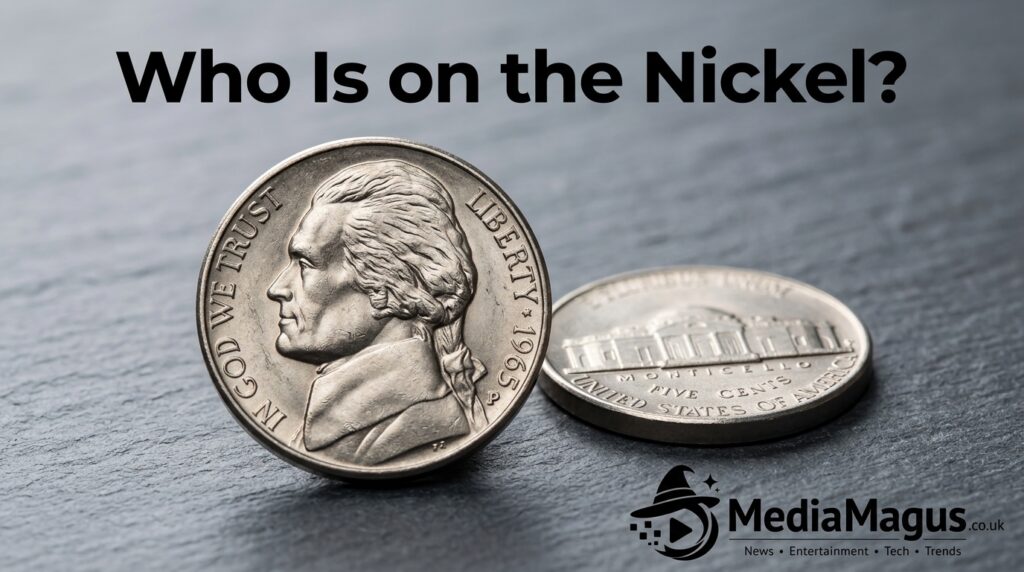

If you have ever looked at a U.S. five cent coin and wondered who is on the nickel, the answer is Thomas Jefferson, the third president of the United States. His portrait appears on the obverse, or heads side, of the modern Jefferson nickel. The reverse, or tails side, features Monticello, Jefferson’s historic Virginia home. The U.S. Mint has used Jefferson on the five cent coin since 1938, although the portrait and reverse design have changed over the decades.
The nickel is worth five cents, but its history is considerably richer than its small face value suggests. It has carried portraits, historic buildings, wildlife, expedition imagery and changing inscriptions over more than a century. Understanding who is on the nickel also opens the door to the history of Thomas Jefferson, the U.S. Mint and some of America’s most recognizable coin designs.
Who Is on the Nickel?
Thomas Jefferson is on the U.S. nickel. He appears on the obverse of the five cent coin, with inscriptions including “LIBERTY” and “IN GOD WE TRUST.” The current portrait was introduced in 2006 and is based on a portrait of Jefferson painted by American artist Rembrandt Peale in 1800. Unlike the traditional side facing portraits seen on many older U.S. coins, the modern Jefferson portrait faces forward.
Jefferson has been associated with the nickel since 1938, when the U.S. Mint replaced the Buffalo nickel with the Jefferson nickel. The original Jefferson design was created by Felix Schlag, whose work placed Jefferson on the front and Monticello on the back. The basic Jefferson and Monticello theme remains one of the longest running designs in American circulating coinage.
For a simple answer to the question “who is on the nickel?”: Thomas Jefferson, the third U.S. president, is on the front of the modern five cent coin.
Why Is Thomas Jefferson on the Nickel?
Thomas Jefferson appears on the nickel because of his importance in American history and his connection to the nation’s founding era. Jefferson was the principal author of the Declaration of Independence and served as the third president of the United States from 1801 to 1809. His presidency included the Louisiana Purchase, which dramatically expanded the territory of the United States.
The connection between Jefferson and the nickel became especially meaningful during the coin’s redesigns in the 2000s. The U.S. Mint’s Westward Journey Nickel Series commemorated the bicentennials of the Louisiana Purchase and the Lewis and Clark expedition. Several temporary reverse designs were issued in 2004 and 2005 before the familiar Monticello reverse returned in 2006.
Jefferson’s connection to the United States
Jefferson’s image is particularly appropriate for a coin because his legacy is closely tied to the founding and expansion of the United States. His presidency included the 1803 Louisiana Purchase, while he also commissioned the Lewis and Clark expedition to explore the newly acquired territory.
These events became the inspiration for the Westward Journey nickel designs. Rather than simply changing the artwork for aesthetic reasons, the U.S. Mint used the opportunity to tell historical stories through the five cent coin.
When Jefferson first appeared on the nickel
Thomas Jefferson first appeared on the nickel in 1938. The design was created by Felix Schlag, who won a U.S. Mint competition involving nearly 400 artists. His winning design placed Jefferson on the obverse and Monticello on the reverse.
The original Jefferson portrait remained on the coin for decades. During the Westward Journey series, the portrait was modified in 2005, and in 2006 the Mint introduced the forward Jefferson portrait that remains associated with modern nickels.
What Is on the Back of a Nickel?
The back of the modern nickel features Monticello, the Virginia estate and home associated with Thomas Jefferson. The building has appeared on the Jefferson nickel’s reverse since the original design was introduced in 1938, although the Mint temporarily replaced it with special designs in 2004 and 2005. The Monticello image returned in 2006 with greater detail and relief.
The reverse includes the words UNITED STATES OF AMERICA, E PLURIBUS UNUM,FIVE CENTS, and MONTICELLO. The combination of Jefferson’s portrait and his home makes the coin immediately recognizable as a Jefferson nickel.
Monticello and its significance
Monticello was Jefferson’s plantation estate near Charlottesville, Virginia. Jefferson designed and repeatedly modified the house, making it one of the best known architectural landmarks associated with an American president.
Its appearance on the nickel creates a direct visual connection between Jefferson and his personal residence. On the coin, Monticello is shown from the front, with the building’s classical architectural features represented in considerable detail.
The inscriptions on the reverse
The reverse of a current nickel contains several important inscriptions. UNITED STATES OF AMERICA identifies the issuing nation, FIVE CENTS identifies the denomination, and E PLURIBUS UNUM is the traditional U.S. motto meaning “Out of many, one.The word MONTICELLO identifies the building shown in the central design.
The obverse carries LIBERTY, IN GOD WE TRUST, Jefferson’s portrait and the date. On 2026 dated nickels, the date appears as “1776 ~ 2026” as part of the U.S. Mint’s 250th anniversary coin program.
How the Nickel Design Has Changed
The modern nickel is not the first five cent coin produced by the United States. In fact, the history of the denomination goes back to the early years of the U.S. Mint.
Early five cent coins
The first five cent coin produced by the U.S. Mint was not made from nickel. It was a small silver coin called a half disme, pronounced “half dime.” The Mint produced these early five cent pieces beginning in the 1790s.
In 1866, the Mint began producing five cent coins made from copper and nickel. These became known as “nickels,” giving the denomination the familiar name that remains in use today. The Mint continued producing the smaller silver half dime until 1873.
Buffalo nickel
From 1913 through 1938, the U.S. Mint produced the famous Buffalo nickel. Designed by sculptor James Earle Fraser, it featured a Native American portrait on the obverse and an American bison on the reverse. The Buffalo nickel is now a popular collectible and is an important part of U.S. coin history.
The Buffalo nickel was replaced in 1938, when Thomas Jefferson took his place on the five cent coin.
Jefferson nickel
The Jefferson nickel debuted in 1938. Felix Schlag’s original design featured Jefferson on the obverse and Monticello on the reverse. Although the design has undergone several modifications, the basic concept has survived for decades.
Westward Journey designs
The U.S. Mint temporarily changed the reverse of the nickel in 2004 and 2005 as part of the Westward Journey Nickel Series. Four different reverse designs commemorated the Louisiana Purchase and Lewis and Clark expedition. These included the Peace Medal, Keelboat, American Bison, and Ocean in View designs.
In 2006, the familiar Monticello reverse returned, while Jefferson’s portrait became a forward facing image. The new portrait was based on Rembrandt Peale’s 1800 portrait of Jefferson.
What Is a Nickel Made Of?
Despite its name, a modern U.S. nickel is not made entirely of nickel metal. The current five cent coin consists of 25% nickel and 75% copper. It weighs 5 grams, measures 21.21 millimeters in diameter, and is 1.95 millimeters thick. Its edge is plain rather than reeded.
| Nickel specification | Current U.S. coin |
|---|---|
| Face value | 5 cents |
| Composition | 25% nickel, 75% copper |
| Weight | 5.00 grams |
| Diameter | 21.21 mm |
| Thickness | 1.95 mm |
| Edge | Plain |
| Obverse | Thomas Jefferson |
| Reverse | Monticello |
The World War II silver alloy nickels
One of the most unusual chapters in nickel history occurred during World War II. Nickel metal was strategically important for the war effort, so the U.S. Mint changed the composition of the five cent coin during the war.
From 1942 through 1945, special nickels were made using an alloy containing copper, silver and manganese. These wartime nickels can be identified by the large mint mark above Monticello on the reverse. The U.S. Mint notes that the “P” mint mark appeared on Philadelphia wartime nickels for the first time.
These wartime nickels are especially interesting to collectors because their composition differs from the standard copper nickel alloy used before and after the war.
Who Designed the Jefferson Nickel?
The original Jefferson nickel was designed by Felix Schlag, who won the U.S. Mint’s design competition in 1938. His design combined a portrait of Thomas Jefferson with an image of Monticello, creating the basic visual identity that continues today.
The modern forward facing Jefferson portrait was introduced in 2006. The portrait was based on Rembrandt Peale’s 1800 painting, while the modern reverse was developed from the classic Monticello design with additional detail and relief. The U.S. Mint credits Jamie Franki with the 2006 obverse design and Felix Schlag with the original 1938 reverse.
How Much Is a Nickel Worth?
A regular circulating nickel is worth five cents, or $0.05, based on its face value. However, individual nickels can be worth more to collectors depending on their date, mint mark, condition, rarity, errors and historical characteristics.
For example, older Buffalo nickels, wartime nickels and certain Jefferson nickel varieties can attract collector interest. A worn modern nickel normally remains a five cent coin, while unusual or scarce pieces may have additional numismatic value.
It is therefore important not to assume that every old nickel is automatically valuable. Collectors typically examine the specific year, mint mark, condition and variety before determining whether a coin deserves a premium.
Interesting Facts About the U.S. Nickel
- The U.S. nickel is worth five cents.
- Thomas Jefferson first appeared on the nickel in 1938.
- Monticello is featured on the modern nickel’s reverse.
- The current nickel contains 25% nickel and 75% copper.
- The first U.S. five cent coin was a silver half disme, not a nickel.
- The Buffalo nickel was produced from 1913 to 1938.
- The Westward Journey Nickel Series introduced special designs in 2004 and 2005.
- The modern forward facing Jefferson portrait began circulating in 2006.
- The 2026 nickel carries the dual date “1776 ~ 2026” as part of the nation’s 250th anniversary coinage.
Conclusion
So, who is on the nickel? Thomas Jefferson. His portrait has represented the U.S. five cent coin since 1938, while Monticello represents him on the reverse. But the nickel’s story goes well beyond a simple portrait: the denomination evolved from the silver half disme, passed through the Buffalo nickel era, changed composition during World War II, and received several historically themed designs in the 2000s.
Today, the Jefferson nickel remains one of America’s most recognizable circulating coins. Its small size and five cent value may make it easy to overlook, but its design preserves important pieces of U.S. history from Jefferson’s presidency and Monticello to the Louisiana Purchase and the nation’s westward expansion.
You may also read more blogs
Frequently Asked Questions
Who is on the nickel?
Thomas Jefferson is on the U.S. nickel. His portrait appears on the obverse, or heads side, of the modern five cent coin. Jefferson has appeared on the nickel since 1938, although his portrait was redesigned for the 2006 coin.
Who is on the back of the nickel?
Monticello, Thomas Jefferson’s Virginia home, appears on the reverse of the modern Jefferson nickel. The building has been part of the Jefferson nickel design since 1938, except for special reverse designs issued during the 2004–2005 Westward Journey series.
When did Thomas Jefferson first appear on the nickel?
Thomas Jefferson first appeared on the U.S. nickel in 1938. The original Jefferson nickel was designed by Felix Schlag, who won a U.S. Mint competition to create the coin’s design.
Is a nickel made entirely of nickel?
No. A modern U.S. nickel contains 25% nickel and 75% copper. Its name comes from the nickel containing alloy rather than meaning the coin is made entirely from nickel metal.
How much does a nickel weigh?
A current U.S. nickel weighs 5.00 grams. It has a diameter of 21.21 millimeters and a thickness of 1.95 millimeters.
What was on the nickel before Thomas Jefferson?
Before the Jefferson nickel, the U.S. Mint produced the Buffalo nickel from 1913 through 1938. It featured a Native American portrait on the obverse and an American bison on the reverse.
Why were some nickels made with silver?
During World War II, nickel metal was needed for military purposes. The U.S. Mint therefore changed the composition of five cent coins and used an alloy containing copper, silver and manganese from 1942 through 1945.
Does every nickel have Monticello on the back?
No. Most Jefferson nickels have Monticello on the reverse, but the U.S. Mint issued four different reverse designs during the 2004 and 2005 Westward Journey Nickel Series. Monticello returned to the reverse in 2006.