
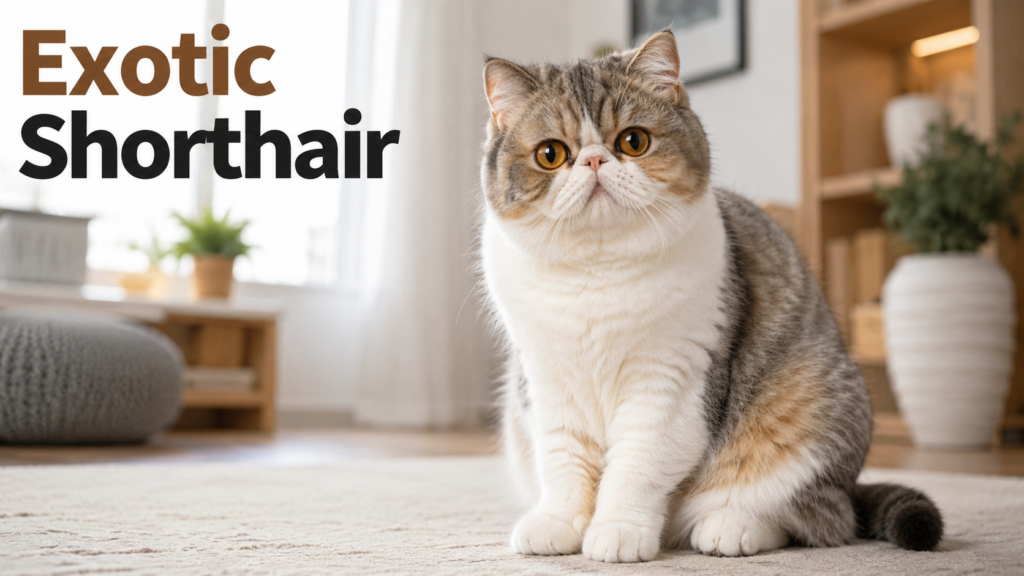

The Exotic Shorthair is a medium sized companion cat developed to retain the characteristic Persian appearance while having a shorter coat. It has a rounded head, large round eyes, short nose, sturdy body and dense coat that gives it a soft, plush appearance.
TICA describes the breed as gentle and affectionate, while CFA notes that Exotics are generally quiet, loyal and adaptable. Their short coat makes them considerably less demanding to groom than a traditional long haired Persian, although they are not completely maintenance free.
The breed is sometimes called the lazy man’s Persian, but that nickname can be misleading. Exotic Shorthairs can be relaxed and cuddly, yet their American Shorthair ancestry contributes curiosity and playfulness.
Exotic Shorthair History and Origin
The breed’s story began in the United States during the 1950s. Persian breeders crossed Persians with American Shorthairs, initially seeking particular physical characteristics, including silver coloring and green eyes.
The resulting cats had the rounded Persian like appearance but short coats. Interest in these cats increased, and the new breed eventually developed its own identity. CFA recognized the Exotic in 1966, while TICA states that the breed received championship recognition there in June 1979.
Over time, breeders increasingly used Persians to establish the desired type. As a result, modern Exotic Shorthairs closely resemble Persians in body structure and facial characteristics, with coat length being one of their most obvious differences.
What Does an Exotic Shorthair Look Like?
The Exotic Shorthair is immediately recognizable because of its rounded proportions and plush appearance.
Typical characteristics include:
- Large, round head
- Large, expressive eyes
- Short nose and compact muzzle
- Small, relatively low set ears
- Short, sturdy legs
- Compact, substantial body
- Short, thick tail
- Dense, plush coat
- Wide range of colors and patterns
CFA describes the breed as having a short, substantial and muscular body with a round head and rich undercoat. TICA similarly describes Exotics as heavily boned cats with broad heads, large eyes and short, thick legs.
Their coat can occur in many colors and patterns, including solid, tabby, silver, golden, shaded, smoke, calico, bicolor and pointed varieties.
This combination of a rounded body, enormous eyes and dense coat is responsible for the breed’s famous teddy bear appearance.
Exotic Shorthair Personality and Temperament
One of the strongest reasons people choose an Exotic Shorthair is its temperament.
These cats are generally affectionate, gentle and people oriented without necessarily demanding constant attention. TICA describes them as easy going companions that may follow their owners from room to room before settling down for a nap nearby. They can also be playful and inquisitive, particularly because of their shorthaired ancestry.
They are typically quieter than highly vocal breeds. Instead of constantly meowing, an Exotic may communicate through purring, soft sounds and body language.
Their personality can be summarized as:
| Trait | Typical tendency |
|---|---|
| Affection | High |
| Activity | Moderate |
| Vocalization | Generally quiet |
| Playfulness | Moderate |
| Sociability | Usually good |
| Grooming tolerance | Generally good |
| Adaptability | Good |
Individual cats can naturally differ. Early socialization, environment, genetics and handling all influence behavior.
Exotic Shorthair Grooming and Daily Care
The shorter coat is one of the breed’s biggest practical advantages, but short haired does not mean no grooming.
The Exotic has a very dense coat and can shed substantially, particularly during seasonal changes. CFA recommends regular combing, with weekly combing often sufficient for much of the year and additional grooming during heavier shedding periods.
A practical routine can include:
- Combing the coat regularly
- Checking the eyes and gently cleaning the surrounding area when necessary
- Keeping nails trimmed
- Monitoring the ears
- Maintaining dental hygiene
- Checking the skin for irritation or abnormalities
Their large eyes and short facial structure also mean owners should pay attention to tear staining and eye cleanliness.
Compared with a Persian, grooming is significantly easier, but prospective owners should still expect routine maintenance.
Exotic Shorthair Health and Lifespan
Health deserves particular attention when considering any cat with a very short facial structure.
TICA lists an expected lifespan of approximately 8–11 years for the breed.
TICA also advises owners of Persian group breeds, including Exotic Shorthairs, to discuss screening for conditions including polycystic kidney disease (PKD), respiratory problems, progressive retinal atrophy (PRA) and hypertrophic cardiomyopathy (HCM) with breeders and veterinarians.
This does not mean every Exotic Shorthair will develop these conditions. Instead, it highlights why responsible breeding and preventive veterinary care are important.
When selecting a kitten, prospective owners should ask the breeder what health testing has been performed on the parents and what veterinary records accompany the kitten.
A responsible owner should also arrange routine veterinary examinations rather than waiting until obvious symptoms appear.
Feeding and Exercise Needs
Exotic Shorthairs can enjoy a relatively relaxed lifestyle, but that does not mean food should be freely available without monitoring.
Their compact build can make maintaining a healthy body condition particularly important. Portion sizes should be based on the individual cat’s age, size, activity level and veterinary recommendations rather than appearance alone.
Daily play is also useful. Interactive toys, puzzle feeders, wand toys and short play sessions can encourage movement while providing mental stimulation.
A simple routine might include several short play sessions rather than expecting the cat to exercise continuously.
Fresh water should always be available, and the overall diet should provide complete and balanced nutrition appropriate for the cat’s life stage.
Is an Exotic Shorthair a Good Family Cat?
For many households, the Exotic Shorthair can be an excellent companion.
TICA notes that the breed generally gets along well with children and other pets, while CFA describes Exotics as adaptable and capable of peacefully coexisting with dogs and other cats.
They can be particularly appealing to people who love the Persian’s appearance but do not want the daily demands of maintaining a long flowing coat.
However, owners should still provide:
- Safe places to rest
- Interactive play
- Regular grooming
- Veterinary care
- Appropriate nutrition
- Gentle handling
- Consistent social interaction
Families with young children should teach children how to handle cats respectfully and give the cat somewhere quiet to retreat.
Exotic Shorthair vs Persian
The Exotic Shorthair and Persian share an exceptionally close relationship, but their coats create a major practical difference.
| Feature | Exotic Shorthair | Persian |
|---|---|---|
| Coat | Short, dense and plush | Long and flowing |
| Grooming | Moderate | High |
| Face | Rounded and short | Rounded and short |
| Temperament | Gentle and affectionate | Gentle and affectionate |
| Activity | Moderate | Generally relaxed |
| Shedding | Can be substantial | Substantial |
| Maintenance | Easier overall | More demanding |
CFA specifically notes that the Exotic was developed with the Persian type while offering a more manageable coat.
So, if appearance is the priority but daily coat maintenance is a concern, the Exotic Shorthair may be the more practical choice.
Choosing an Exotic Shorthair Kitten
Buying an Exotic Shorthair should involve more than choosing the kitten with the biggest eyes or flattest face.
Look for a breeder who is transparent about health testing, veterinary care, lineage and socialization. TICA provides a breeder directory and states that its member breeders agree to its Code of Ethics.
Before committing, ask about:
- Parent health screening
- Veterinary examination
- Vaccination records
- Parasite treatment
- Registration or pedigree documentation where applicable
- Kitten socialization
- Breeder return or support policies
- Any known hereditary concerns in the bloodline
Be especially cautious of sellers who cannot provide meaningful health information or who focus exclusively on extreme facial features.
The healthiest choice is generally a kitten bred with sound structure and welfare in mind rather than appearance alone.
Conclusion
The Exotic Shorthair is a compelling choice for people who love the rounded appearance and gentle personality associated with Persian type cats but prefer a shorter, more manageable coat. Its plush appearance, affectionate nature and moderate activity level make it suitable for many households.
However, its distinctive facial structure means health and responsible breeding should be considered alongside appearance. Choosing a reputable breeder, maintaining regular grooming and veterinary care, controlling nutrition and providing daily enrichment can help an Exotic Shorthair enjoy a comfortable life.
Frequently Asked Questions
Is an Exotic Shorthair a Persian?
The Exotic Shorthair is a separate recognized breed, but it was developed from Persian breeding and shares the Persian’s characteristic body and head type. The major visual distinction is its short, dense coat.
Are Exotic Shorthairs good house cats?
Yes. Their generally gentle, adaptable and affectionate temperament makes them well suited to indoor family life. They can live comfortably in different household environments when provided with companionship, enrichment and appropriate care.
Do Exotic Shorthairs need daily brushing?
Usually not. Their dense short coat generally requires less grooming than a Persian. CFA says weekly combing is sufficient for much of the year, although grooming needs can increase during shedding periods.
Are Exotic Shorthairs affectionate?
Yes. They are generally affectionate without being excessively demanding. Many enjoy following their owners, sitting nearby or relaxing on a lap.
How long do Exotic Shorthair cats live?
TICA gives an expected lifespan of approximately 8–11 years. Individual longevity can vary depending on genetics, health, nutrition, veterinary care and lifestyle.
Do Exotic Shorthairs get along with other pets?
They generally can. TICA and CFA both describe the breed as easy going and capable of living successfully with children and other animals when properly introduced.
Are Exotic Shorthairs high maintenance?
They are generally lower maintenance than Persians because their coat is short, but they still need regular grooming, eye care, dental care, nail trimming, exercise and veterinary attention.
What health problems can Exotic Shorthairs have?
Potential concerns associated with Persian group cats include PKD, respiratory problems, PRA and HCM. Prospective owners should discuss appropriate screening with breeders and veterinarians.
You may also read more blogs