
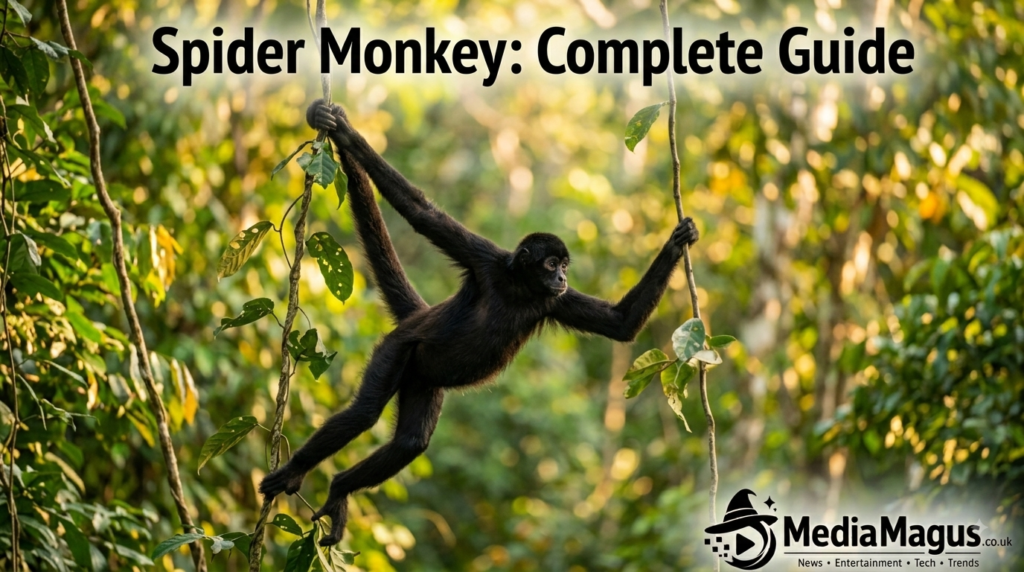

The spider monkey is one of the most recognizable primates in the Americas, known for its long limbs, gripping tail, and near constant motion through the rainforest canopy. But spider monkey isn’t a single animal it’s a genus of seven distinct species, several of which are now critically endangered. This guide breaks down what actually separates them, how they live, and why some populations are disappearing faster than others.
What Is a Spider Monkey
Spider monkeys belong to the genus Ateles, part of the family Atelidae within the New World monkey group (Platyrrhini). They’re native exclusively to the tropical forests of Central and South America, ranging from southern Mexico down through Brazil. The name comes from their appearance in motion: when a spider monkey swings through branches with its long arms, legs, and tail extended, it resembles a spider dangling on a web.
They’re classified as New World monkeys, which distinguishes them from Old World monkeys (like baboons and macaques) in a few concrete ways flatter noses with sideways facing nostrils, and, in the case of Ateles specifically, a prehensile tail strong enough to support their full body weight. No Old World monkey has this ability.
Spider Monkey Species
Taxonomists currently recognize seven species of spider monkey, and their conservation status varies dramatically a detail most general audience articles skip entirely.
| Species | Common Name | Range | IUCN Status |
|---|---|---|---|
| Ateles geoffroyi | Geoffroy’s spider monkey | Mexico to Panama | Endangered |
| Ateles fusciceps | Black headed spider monkey | Colombia, Ecuador, Panama | Critically Endangered |
| Ateles hybridus | Brown/variegated spider monkey | Colombia, Venezuela | Critically Endangered |
| Ateles belzebuth | White bellied spider monkey | Amazon Basin (Brazil, Peru, Ecuador) | Endangered |
| Ateles chamek | Peruvian spider monkey | Peru, Bolivia, Brazil | Endangered |
| Ateles paniscus | Red faced (black) spider monkey | Guiana Shield, northern Brazil | Vulnerable |
| Ateles marginatus | White whiskered spider monkey | South central Brazil | Endangered |
The brown spider monkey (Ateles hybridus) is often cited by primatologists as one of the 25 most endangered primates on Earth, with an estimated population decline of more than 80% over the past 45 years, largely due to deforestation in the Magdalena Valley of Colombia.
Physical Characteristics
Spider monkeys are built for a life spent almost entirely off the ground. Adults typically weigh between 13 and 24 pounds (6–11 kg) and measure 14 to 26 inches (35–66 cm) in body length, with a tail that’s often longer than the body itself up to 33 inches (84 cm).
Key physical traits:
- Prehensile tail with a bare fingerprint patch on the underside near the tip, which improves grip the same way a human fingertip does
- Reduced or absent thumbs spider monkeys have hook like hands with four long fingers, which is actually an adaptation for faster brachiation (swinging), not a disadvantage
- Long, spindly limbs, giving them one of the highest limb to body ratios of any primate
- Fur color varies by species, ranging from black and dark brown to reddish and golden brown, often with a lighter underside
This limb structure makes spider monkeys among the fastest and most efficient brachiators in the primate world some individuals have been recorded moving through the canopy at speeds comparable to a human sprinting, without ever touching the ground.
Habitat and Range
Spider monkeys are canopy specialists. They live in the upper and middle levels of tropical rainforests, cloud forests, and semi deciduous forests, rarely descending to the forest floor. Their range stretches from the Mexican state of Veracruz, through Central America, and across much of the Amazon Basin into Brazil, Peru, Bolivia, Colombia, Ecuador, and the Guianas.
Because they’re highly dependent on unbroken, mature forest canopy, spider monkeys are considered an indicator species their presence or absence is often used by conservationists as a proxy for overall forest health. A forest fragment too small or too degraded to support spider monkeys typically can’t support the broader biodiversity that depends on continuous canopy either.
Diet and Feeding Behavior
Spider monkeys are primarily frugivorous, meaning ripe fruit makes up 80–90% of their diet in most populations. The remainder is supplemented with young leaves, flowers, bark, honey, and occasionally insects or bird eggs.
This heavy fruit dependence makes spider monkeys critical seed dispersers. A single troop can disperse seeds from dozens of tree species across large distances in a single day, and research in Costa Rica’s forests has linked healthy spider monkey populations directly to higher tree species diversity in the areas they inhabit. When spider monkeys disappear from a forest, seed dispersal patterns measurably change within a few generations of trees.
Social Behavior and Communication
Spider monkeys live in a fission fusion society one of the more complex social systems among primates. A single community can include 20 to 40 individuals, but they rarely travel together as one group. Instead, they split into smaller subgroups of 2 to 8 that change composition throughout the day depending on food availability, then fuse back into the larger community periodically.
Females are the primary drivers of dispersal: unlike many primate species, female spider monkeys typically leave their birth group at sexual maturity, while males tend to stay in their natal community for life. This is relatively rare among primates and gives spider monkey troops unusually strong male kinship bonds.
Communication includes:
- Long distance vocalizations (barks and whinnies) to coordinate subgroup locations
- Branch shaking displays as a threat or warning signal
- Scent marking using chest glands, more common in males
Reproduction and Lifespan
Female spider monkeys reach sexual maturity around 4 to 5 years old, males slightly later. Gestation lasts roughly 226 to 232 days (about 7.5 months), and females typically give birth to a single infant, with twins being extremely rare.
Interbirth intervals are long often 3 to 4 years because infants remain dependent on their mothers for an extended period, riding on her back for up to a year and staying close for several more. This slow reproductive rate is one reason spider monkey populations recover so slowly after habitat loss or hunting pressure, compared to faster breeding primates.
In the wild, spider monkeys typically live 20 to 27 years; in managed care, some individuals have reached over 40 years old.
Spider Monkey vs Other Monkeys
Spider monkeys are frequently confused with howler monkeys and capuchins, since all three share overlapping ranges in Central and South America. Here’s how they actually differ:
| Trait | Spider Monkey | Howler Monkey | Capuchin Monkey |
|---|---|---|---|
| Tail | Fully prehensile, bare grip patch | Fully prehensile, bare grip patch | Semi prehensile, less grip strength |
| Thumbs | Reduced/absent | Present | Present, fully opposable |
| Diet | Mostly fruit | Mostly leaves | Omnivorous (fruit, insects, small vertebrates) |
| Movement style | Brachiation (arm swinging) | Slower, deliberate climbing | Quadrupedal walking/climbing |
| Signature trait | Speed and canopy acrobatics | Extremely loud vocalizations (audible 3+ miles) | Tool use, high intelligence |
The clearest field identifier: if you see a monkey swinging armover arm at speed with no visible thumbs, it’s almost certainly a spider monkey.
Conservation Status and Threats
Every spider monkey species faces some level of population decline, but the causes and severity differ:
- Habitat loss is the dominant threat across all species agricultural expansion, cattle ranching, and logging have fragmented the continuous canopy spider monkeys require
- Hunting for bushmeat remains significant in parts of the Amazon and Central America, where spider monkeys are targeted specifically because of their relatively large body size compared to other monkeys
- Slow reproduction rate compounds both threats a population that loses adults to hunting or habitat pressure can take decades to recover, if it recovers at all
- Pet trade affects some populations, particularly Geoffroy’s spider monkey, though this is a smaller driver than habitat loss
Conservation organizations including the IUCN Primate Specialist Group have repeatedly flagged the brown spider monkey and black headed spider monkey as priority species, given their Critically Endangered status and the ongoing rate of deforestation in their specific ranges.
Interesting Facts About Spider Monkeys
- A spider monkey’s tail is so dexterous it can pick up a single piece of fruit without any help from the hands
- They’re one of only a handful of primate genera where females, not males, disperse from their birth troop
- Spider monkeys have no external thumb, but this is an evolutionary trade off that makes their swinging locomotion faster and more efficient, not a deficiency
- Some spider monkey populations have been observed engaging in self medication behavior, selectively eating certain plants that may have anti parasitic properties
Final Thoughts
Spider monkeys aren’t just another rainforest primate they’re a keystone species whose loss reshapes the forests around them, largely because of how much they do for seed dispersal. Understanding the differences between species, rather than treating “spider monkey” as one uniform animal, is the difference between a surface level overview and actually knowing what’s at stake for a genus where several members are now among the most endangered primates on the planet.
Explore more wildlife
Frequently Asked Questions
What do spider monkeys eat?
Spider monkeys are mostly frugivorous, with ripe fruit making up roughly 80–90% of their diet. They also eat young leaves, flowers, and occasionally insects or bird eggs.
Where do spider monkeys live?
Spider monkeys live in the tropical rainforest canopy of Central and South America, from southern Mexico through the Amazon Basin into Brazil, Peru, and Bolivia.
Are spider monkeys endangered?
Most spider monkey species are Endangered or Critically Endangered, according to the IUCN. The brown spider monkey and black headed spider monkey are among the most at risk, primarily due to deforestation.
Why don’t spider monkeys have thumbs?
Spider monkeys have reduced or absent thumbs as an evolutionary adaptation for faster, more efficient arm swinging (brachiation) through the forest canopy, rather than a physical limitation.
How long do spider monkeys live?
In the wild, spider monkeys typically live 20 to 27 years. In zoos or sanctuaries, some individuals have lived past 40 years.
How is a spider monkey different from a howler monkey?
Both have prehensile tails, but spider monkeys have reduced thumbs and move by fast arm swinging, while howler monkeys have full thumbs, move more slowly, and are known for extremely loud vocal calls audible for miles.
Do spider monkeys live in groups?
Yes, spider monkeys live in fission fusion communities of 20–40 individuals that split into smaller subgroups of 2–8 throughout the day and periodically reunite.
Can spider monkeys be kept as pets?
It’s illegal in most countries and strongly discouraged by conservation groups. Spider monkeys are wild, socially complex animals with specialized dietary and social needs that can’t be met in a household setting, and the pet trade contributes to wild population decline.