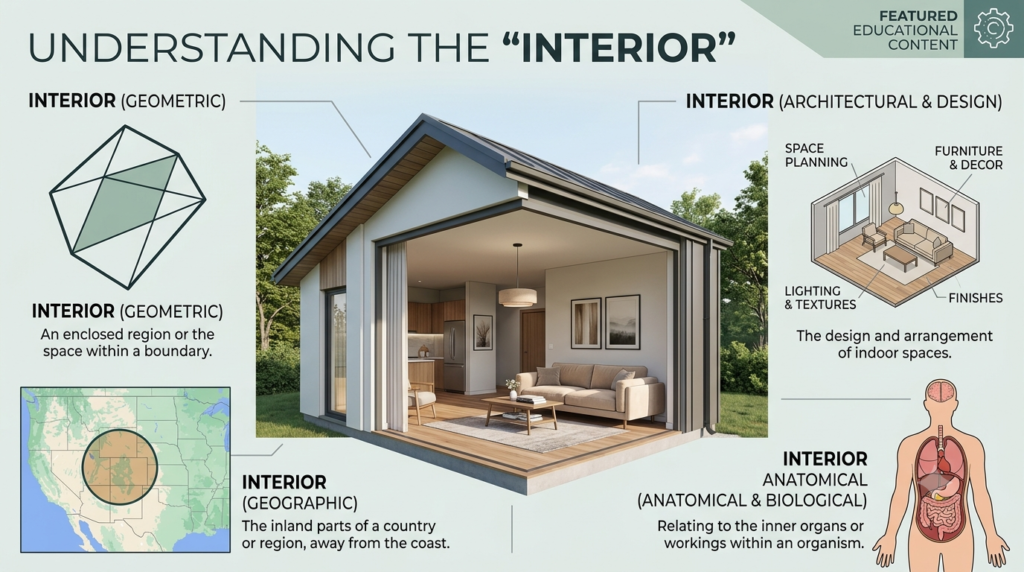

Interior Define: The word interior generally refers to the inside part of something, especially when compared with its outside or exterior. In simple terms, if the exterior is the outer surface or appearance of something, the interior is what is found inside.
For example, the rooms inside a house are part of the home’s interior. The inside of a car is its interior, while the bodywork and outer surface are part of its exterior. The interior of a building may include rooms, hallways, furniture, lighting, flooring, ceilings, and decorative elements.
The word can also be used as an adjective. In this form, interior describes something that is located inside or relates to the inner part of something. For example, an interior wall is a wall inside a building, while an interior space refers to an indoor area.
Interior Meaning in Simple English
In simple English, interior means the inside of something. It is the opposite of exterior, which means the outside.
A basic example is a house. The outside walls, roof, windows, and doors form part of the exterior. The living room, bedroom, kitchen, bathroom, furniture, and decorations are all part of the interior.
The word may also describe the inner part of a country or region. For example, when people refer to the interior of a country, they usually mean areas located away from the coast or borders.
Interior vs Exterior: What Is the Difference?
The easiest way to understand the meaning of interior is to compare it with exterior. These two words are opposites and are commonly used together when describing buildings, vehicles, objects, and spaces.
The interior refers to the inside, while the exterior refers to the outside. For example, the interior of a car includes its seats, dashboard, steering wheel, carpets, and entertainment system. The exterior includes the doors, windows, tires, paint, lights, and body of the vehicle.
The same distinction applies to architecture and home design. Interior design focuses on how indoor spaces look and function, whereas exterior design focuses on the appearance and surroundings of the outside of a building.
Interior and Exterior Examples
Consider a modern house. Its interior may include an open plan kitchen, comfortable furniture, wooden flooring, decorative lighting, and artwork. These elements are experienced when a person enters the building.
The exterior may include the building’s facade, roof, driveway, garden, windows, and front entrance. Both areas contribute to the overall appearance and function of a property, but they represent different sides of the same structure.
Understanding the difference between interior and exterior is useful when discussing architecture, construction, real estate, automobiles, product design, and home improvement.
What Does Interior Mean in Interior Design?
In interior design, the word interior refers to the indoor environment of a building or space. Interior design is the process of planning and improving these spaces to make them functional, comfortable, attractive, and suitable for the people who use them.
Interior design can involve many different elements. These may include furniture, color schemes, lighting, flooring, wall treatments, ceilings, storage, textiles, artwork, and decorative accessories. A professional designer considers how all these components work together.
The goal is not simply to make a room look beautiful. Good interior design also considers how people move through a space, how the room is used, how much natural light it receives, and how the design can support comfort and practicality.
What Is an Interior Designer?
An interior designer is a professional who plans and develops the design of indoor spaces. Depending on the project, an interior designer may work on residential homes, offices, hotels, restaurants, retail stores, hospitals, or other commercial environments.
Interior designers often consider space planning, materials, furniture, lighting, colors, and finishes. They may also collaborate with architects, contractors, engineers, and other professionals during construction or renovation projects.
The exact responsibilities of an interior designer can vary by location and project. However, the central purpose is to create interior spaces that balance function, safety, comfort, and visual appeal.
Interior Definition in Architecture
In architecture, the term interior generally describes the inside spaces of a building. These spaces are designed as part of the overall architectural concept and can include everything from the structural arrangement of rooms to the finishes and materials visible to occupants.
Architectural interiors may include walls, ceilings, floors, staircases, doors, windows, columns, and other structural or decorative features. The design of these elements affects how a building feels and functions.
Architecture and interior design are closely related but are not identical. Architecture typically focuses more broadly on the design and construction of buildings and their relationship with the surrounding environment. Interior design focuses more specifically on the experience and functionality of spaces inside.
Why Is Interior Architecture Important?
Interior architecture considers how the internal structure and layout of a building support the needs of its users. It may involve decisions about room layouts, circulation, natural light, acoustics, materials, and spatial relationships.
A well designed interior can make a building easier to use and more comfortable. For example, a well planned office may improve movement and collaboration, while a thoughtfully designed home may provide better storage and more flexible living areas.
The interior environment can also influence mood and behavior. Lighting, proportions, colors, textures, and materials can all contribute to how people experience a space.
What Does Interior Mean in Geography?
In geography, interior can refer to the area located inside a country or region, particularly areas that are far from the coast. The meaning depends on the geographical context.
For example, a country may have coastal regions and an interior region. When someone says that a city is located in the interior of a country, they generally mean that it is situated away from the coastline.
The term is often used in discussions about climate, population distribution, transportation, agriculture, and economic development. Interior areas may have different environmental and economic characteristics from coastal areas.
Interior Region Meaning
An interior region is generally understood as an area located toward the central or inland part of a larger geographical area.
For example, the interior of a continent includes areas that are not close to the ocean. Such locations may experience different weather patterns from coastal areas because they are less influenced by the moderating effects of large bodies of water.
The word interior in geography should therefore be understood according to the specific location being discussed. It does not always mean the exact geographic center.
What Does Interior Mean in Mathematics?
In mathematics, particularly in topology and geometry, the word interior has a more precise technical meaning.
The interior of a set is the collection of all points that belong to the set and have a small neighborhood entirely contained within that set. In simpler terms, interior points are points that are not located on the boundary.
For example, imagine a filled circle. Points located inside the circle are interior points, while points along the circumference form the boundary. The interior is therefore different from the boundary and the exterior.
Interior Angles and Geometry
In geometry, the term interior is also used to describe angles and regions located inside geometric figures.
For example, an interior angle is an angle formed inside a polygon. A triangle has three interior angles, and the sum of those angles is always 180 degrees.
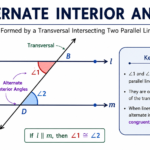
When two parallel lines are crossed by a transversal, the angles located between the parallel lines are called interior angles. This is why terms such as alternate interior angles and same side interior angles are commonly used in geometry.
The mathematical meaning of interior is therefore connected to the idea of being inside a defined boundary or region.
What Is an Interior Space?
An interior space is an area located inside a building or structure. It may be a private residential room, a commercial workplace, a public facility, or another enclosed environment.
Interior spaces are designed according to their intended purpose. A bedroom is typically designed for rest, while a kitchen is designed for food preparation and storage. An office may prioritize productivity, collaboration, and organization.
The best interior spaces combine practical requirements with visual design. Factors such as natural lighting, artificial lighting, ventilation, furniture placement, acoustics, accessibility, and circulation can all affect the quality of an interior environment.
Elements That Define an Interior Space
Several key elements contribute to the identity of an interior space. These include space, light, color, texture, materials, furniture, proportion, scale, and decoration.
Space determines how large or open a room feels. Lighting can influence mood and visibility. Colors can make a room appear warmer, cooler, larger, or more intimate. Materials and textures add visual and physical character.
Furniture and decorative objects also contribute to the overall design. When these elements are carefully coordinated, they can create an interior that feels cohesive and purposeful.
What Is Interior Design Used For?
Interior design is used to improve the functionality, comfort, safety, and appearance of indoor environments. It can be applied to homes, offices, schools, hotels, restaurants, healthcare facilities, retail stores, and many other spaces.
In residential design, the focus may be on creating comfortable living areas that reflect the lifestyle and preferences of the occupants. In commercial design, the priorities may include brand identity, customer experience, employee productivity, and efficient use of space.
Interior design can also contribute to sustainability. Designers may select energyefficient lighting, durable materials, recycled products, and environmentally responsible finishes to reduce environmental impact.
Residential Interior Design
Residential interior design focuses on homes and living spaces. It may include the design of bedrooms, living rooms, kitchens, bathrooms, dining areas, home offices, and outdoor connected spaces.
A successful residential interior should reflect the needs of the people who live there. A family home may require durable materials and generous storage, while a small apartment may benefit from multifunctional furniture and efficient space planning.
The best approach is to balance personal style with everyday practicality. A beautiful room that is difficult to use will not provide the same long term value as a space that combines appearance and function.
Commercial Interior Design
Commercial interior design focuses on spaces used by businesses and organizations. Examples include offices, hotels, restaurants, shops, salons, clinics, and educational facilities.
Commercial interiors often have additional requirements because they need to serve employees, customers, visitors, or patients. The design may need to support branding, accessibility, safety, customer movement, and operational efficiency.
A well-designed commercial interior can influence how people perceive a business. The environment may communicate professionalism, luxury, creativity, reliability, or a particular brand identity.
Interior Meaning in Everyday Language
In everyday language, “interior” is often used simply to describe something that is inside.
For example, someone may talk about the interior of a house, the interior of a vehicle, or the interior of a room. In these cases, the meaning is straightforward and refers to the internal area or appearance.
The word can also be used metaphorically. Expressions such as “inner life” or “interior thoughts” refer to a person’s private feelings, emotions, or mental experiences. This usage connects the physical idea of “inside” with an abstract idea of inner experience.
Interior as a Noun and Adjective
Interior can function as both a noun and an adjective.
As a noun, it can refer to the inside of something. For example, The interior of the building was recently renovated.
As an adjective, it describes something related to the inside. For example, “The company installed new interior doors.”
Recognizing these two uses can make the word easier to understand in different sentences and contexts.
Why Is the Meaning of Interior Important?
Understanding the definition of interior is useful because the word appears across many subjects. It is common in everyday conversations but also has specialized meanings in design, architecture, mathematics, geography, and other fields.
The central idea remains consistent: interior generally relates to what is inside, within, or inward. The exact definition changes slightly depending on the subject.
Learning context is therefore important. When discussing a house, interior means the inside space. In geometry, it may refer to a region or angle inside a shape. In geography, it may describe inland areas. In personal or philosophical language, it can refer to inner thoughts or experiences.
Common Examples of Interior
The word interior can be understood more easily through practical examples.
The interior of a car includes its seats, dashboard, steering wheel, and other components located inside the vehicle. The interior of a house includes its rooms and indoor features.
An interior wall is a wall located inside a building. An interior door separates rooms within a building, while an exterior door usually provides access between the inside and outside.
In geometry, an interior angle is located inside a polygon. In geography, an interior region generally refers to an inland area.
These examples demonstrate that although the word can be used in different ways, its core concept remains connected to the idea of being inside.
Interior Synonyms and Related Words
Depending on the context, several words may have a similar meaning to interior. Common alternatives include inside, inner, internal, inward, central, enclosed, indoor, and inland.
However, these words are not always interchangeable. For example, indoor usually refers to an activity or environment inside a building, while “internal” can describe something located within a system or organization.
In interior design, related terms include indoor space, home decor, interior architecture, spatial design, room design, and interior styling. Understanding these related terms can help explain the broader concept.
Interior Antonyms
The most common antonym of interior is exterior.
Other contrasting words may include outside, outer, external, outward, or outdoor, depending on the sentence.
For example, an interior designer focuses on indoor environments, while exterior design focuses on the outside appearance of a structure. Similarly, an interior region may be contrasted with a coastal or peripheral region.
Conclusion
The keyword interior define most likely refers to a search for the definition and meaning of the word interior. In its simplest form, interior means the inside part of something, making it the opposite of exterior. However, the word has a broader range of meanings. In interior design and architecture, it refers to indoor spaces and their planning. In geography, it can describe inland areas. In mathematics and geometry, it identifies regions or points located within boundaries. In everyday language, it can also describe a person’s inner thoughts or experiences
Frequently Asked Questions About Interior Define
What does interior mean in simple words?
Interior means the inside part of something. It can describe the inside of a building, vehicle, object, geographical area, or even a person’s inner thoughts, depending on the context.
What is the opposite of interior?
The most common opposite of interior is exterior. Interior refers to the inside, while exterior refers to the outside.
What is the definition of interior design?
Interior design is the process of planning and improving indoor spaces to make them functional, comfortable, safe, and visually appealing. It can involve space planning, furniture, lighting, colors, materials, and decoration.
What is an interior space?
An interior space is an area located inside a building or structure. Examples include living rooms, bedrooms, offices, kitchens, restaurants, and hotel rooms.
What does interior mean in architecture?
In architecture, interior generally refers to the internal spaces and features of a building. It can include room layouts, walls, ceilings, floors, stairs, lighting, materials, and other elements experienced inside the structure.
What does interior mean in geometry?
In geometry, interior refers to the area or region inside a shape or boundary. The term is also used for interior angles, which are angles located inside geometric figures.
What is an interior designer?
An interior designer is a professional who plans and develops indoor environments. Their work may involve space planning, furniture, lighting, materials, colors, finishes, and other elements of interior spaces.
Is interior the same as inside?
Interior and inside often have similar meanings, but interior is generally more formal and can be used as a noun or adjective. For example, “the interior of a car” means the inside of the car..
You may also read more blogs