
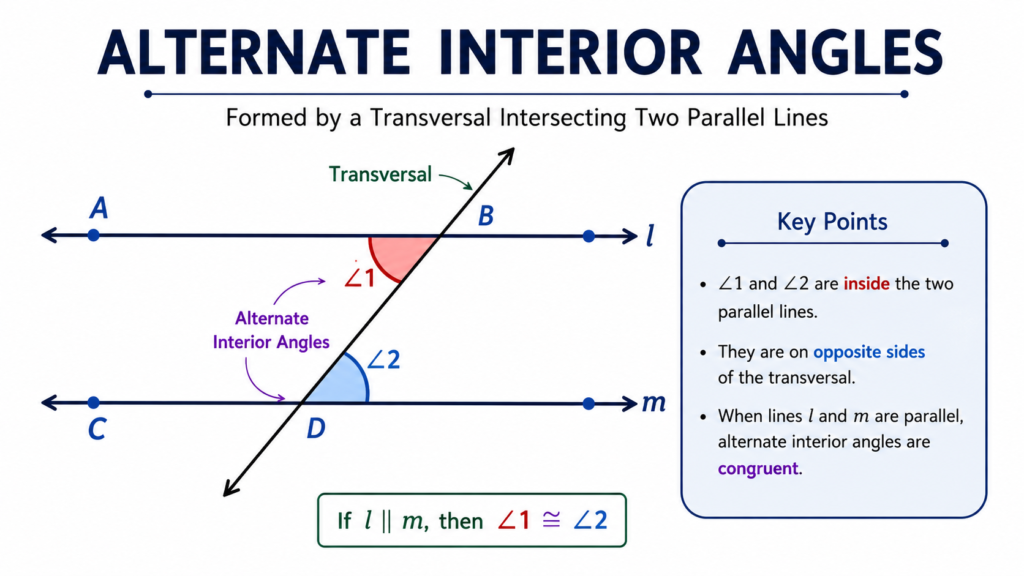

Understanding alternate interior angles is an important part of learning geometry, especially when studying parallel lines cut by a transversal. This angle relationship appears frequently in geometry lessons, diagrams, proofs, and mathematical problem solving. Once you understand where these angles are located and why they have a special relationship, many geometry questions become much easier to solve.
In simple terms, alternate interior angles are a pair of angles that lie between two lines and are positioned on opposite sides of a transversal. When the two lines are parallel, these angles are congruent, meaning they have the same measure. This property is known as the alternate interior angles theorem and is one of the most useful angle rules in elementary and intermediate geometry.
What Are Alternate Interior Angles?
Alternate interior angles are two angles located inside the space between two lines and on opposite sides of a transversal. A transversal is a line that crosses or intersects two other lines. When a transversal crosses two parallel lines, it creates several pairs of angles, including corresponding angles, alternate exterior angles, and same side interior angles.
The word interior tells us that the angles are located between the two lines. The word alternate means that the angles appear on opposite sides of the transversal. Therefore, to identify alternate interior angles, you need to check two things: both angles must be inside the two lines, and they must lie on opposite sides of the transversal.
When two parallel lines are crossed by a transversal, alternate interior angles have equal measures. For example, if one alternate interior angle measures 65 degrees, its alternate interior angle also measures 65 degrees. This relationship makes it possible to find unknown angles without measuring them directly.
Simple Definition
A concise definition of alternate interior angles is:
Alternate interior angles are a pair of non adjacent angles located between two lines and on opposite sides of a transversal. If the two lines are parallel, the alternate interior angles are congruent.
Consider two parallel horizontal lines crossed by a diagonal transversal. The angles located in the region between the horizontal lines are interior angles. If you select one interior angle on the left side of the transversal and another interior angle on the right side, those two angles may form an alternate interior pair.
The angles do not need to be next to each other. In fact, alternate interior angles are generally separated by the transversal and occur at different intersection points. Their special relationship comes from the geometry created when a transversal crosses parallel lines.
How to Identify Alternate Interior Angles
Identifying alternate interior angles becomes much easier when you follow a simple visual process. First, locate the two lines being crossed. Next, identify the transversal. Then look at the region between the two lines. Finally, find pairs of angles that are on opposite sides of the transversal.
For example, imagine two parallel horizontal lines and a diagonal line crossing both. The diagonal line is the transversal. The area between the two horizontal lines is the interior region. Any angles inside that region are interior angles, while angles outside the two lines are exterior angles.
Look for Opposite Sides
The most important feature of alternate interior angles is that they lie on opposite sides of the transversal. If both angles are between the two lines but appear on the same side of the transversal, they are not alternate interior angles. Instead, they are called same side interior angles or consecutive interior angles.
Suppose an angle inside the parallel lines is located to the left of the transversal. Its alternate interior partner will be inside the parallel lines on the right side of the transversal. These two angles form an alternate interior pair.
A useful memory trick is to think of the word alternate as meaning “switch sides.” The angles are interior because they are inside the two lines, and they are alternate because they switch to opposite sides of the transversal.
Alternate Interior Angles and Parallel Lines
The relationship between alternate interior angles becomes especially important when two lines are parallel. When a transversal intersects two parallel lines, the resulting alternate interior angles are always congruent.
For example, if two parallel lines are crossed by a transversal and one alternate interior angle measures 110 degrees, the other alternate interior angle also measures 110 degrees. No additional measurement is required because the parallel lines guarantee the angle relationship.
This is one of the reasons parallel lines are so important in geometry. A diagram containing parallel lines provides valuable information about angle measures. By recognizing the correct angle relationship, you can often solve a problem using only the information already given.
Why Are They Congruent?
When a transversal crosses two parallel lines, the geometry of the intersections creates equal angle relationships. The direction of the transversal relative to each parallel line is consistent, which causes corresponding angle measures to match. From these relationships, alternate interior angles are also equal.
The key condition is that the lines must be parallel. If two lines are not parallel, their alternate interior angles are not automatically congruent. They may happen to have equal measures in a particular diagram, but you cannot assume equality simply because the angles appear to be alternate and interior.
This distinction is essential when solving geometry problems. Always check whether the problem states that the lines are parallel or provides markings, such as matching arrow symbols, that indicate parallel lines.
Alternate Interior Angles Theorem
The alternate interior angles theorem states that if two parallel lines are cut by a transversal, then each pair of alternate interior angles is congruent. In mathematical language, if two lines are parallel, the measures of their alternate interior angles are equal.
The theorem can be expressed as:
If two parallel lines are intersected by a transversal, then alternate interior angles are congruent.
This theorem allows you to identify an unknown angle by comparing it with its alternate interior partner. If the known angle is 72 degrees, the corresponding alternate interior angle must also be 72 degrees.
Using the Theorem
To use the alternate interior angles theorem, first identify the two parallel lines and the transversal. Then locate the two angles being compared. Confirm that both angles are inside the parallel lines and on opposite sides of the transversal.
Once you have confirmed that they form an alternate interior pair, you can set their measures equal. For example, if one angle is represented by x + 20 and its alternate interior angle is 80 degrees, you can write:
x + 20 = 80
Solving the equation gives:
x = 60
The theorem therefore turns a geometry diagram into a straightforward algebra problem.
Examples of Alternate Interior Angles
Learning the definition is useful, but examples make the concept much easier to recognize. Imagine two parallel lines labeled Line A and Line B. A diagonal transversal crosses both lines. At the upper intersection, an interior angle on the left side of the transversal measures 55 degrees. At the lower intersection, the interior angle on the right side of the transversal is its alternate interior partner.
Because the lines are parallel, the two angles are congruent. Therefore, the second angle also measures 55 degrees.
This example demonstrates the central idea: alternate interior angles are not necessarily located at the same intersection. They occur at different intersections created by the transversal, but their positions relative to the two lines and the transversal create the special relationship.
Algebraic Example
Suppose two parallel lines are crossed by a transversal. One alternate interior angle is labeled 3x + 15, while the other is labeled 5x – 25. Because the angles are alternate interior angles, they are congruent.
Set the expressions equal:
3x + 15 = 5x – 25
Add 25 to both sides:
3x + 40 = 5x
Subtract 3x:
40 = 2x
Therefore:
x = 20
Now substitute x = 20 into either expression:
3(20) + 15 = 75
The angle measures 75 degrees. The other angle also measures 75 degrees because alternate interior angles formed by parallel lines are congruent.
This type of question combines geometry and algebra. The key step is recognizing the angle relationship before creating the equation.
Alternate Interior Angles vs Other Angle Pairs
Geometry includes several angle relationships that can look similar in diagrams. Understanding the differences between them is important because each relationship has its own rule.
Alternate interior angles are inside the two lines and on opposite sides of the transversal. Corresponding angles occupy matching positions at the two intersections. Same side interior angles are inside the lines but on the same side of the transversal. Alternate exterior angles are outside the two lines and on opposite sides of the transversal.
Knowing these distinctions prevents common mistakes. Before applying an angle theorem, carefully examine both the location of each angle and its position relative to the transversal.
Corresponding Angles
Corresponding angles are located in matching positions at each intersection. If a transversal crosses two parallel lines, corresponding angles are congruent.
For example, an angle in the upper right position at the first intersection corresponds to the angle in the upper right position at the second intersection. Unlike alternate interior angles, corresponding angles do not have to be inside the two lines.
The easiest way to distinguish the two is to focus on their positions. Alternate interior angles are inside and on opposite sides of the transversal. Corresponding angles are in the same relative position at each intersection.
Same Side Interior Angles
Same side interior angles, sometimes called consecutive interior angles, are located between the two lines and on the same side of the transversal. When the two lines are parallel, these angles are supplementary rather than congruent.
Supplementary angles have a sum of 180 degrees. Therefore, if one same side interior angle measures 70 degrees, the other measures 110 degrees.
This is a major difference between alternate interior angles and same side interior angles. Alternate interior angles are equal when parallel lines are involved, while same side interior angles add up to 180 degrees.
Alternate Exterior Angles
Alternate exterior angles are located outside the two lines and on opposite sides of the transversal. When the lines are parallel, alternate exterior angles are congruent.
The word exterior is the key difference. Alternate interior angles are between the lines, while alternate exterior angles are outside them. Both relationships involve opposite sides of the transversal.
How to Find Missing Alternate Interior Angles
Finding a missing angle using alternate interior angles is usually straightforward. Begin by identifying the two lines and the transversal. Look for the parallel line markings or read the information provided in the question.
Next, identify whether the unknown angle and the known angle are alternate interior angles. They should both be between the two lines and located on opposite sides of the transversal. If they meet these conditions and the lines are parallel, their measures are equal.
Step by Step Method
A simple method for solving these problems is:
Identify the parallel lines: Confirm which lines are parallel.
Find the transversal: Locate the line that intersects both parallel lines.
Locate the interior region: Focus on the space between the parallel lines.
Check opposite sides: Make sure the two angles are on opposite sides of the transversal.
Apply congruence: Set the angle measures equal.
Solve for the variable: If algebraic expressions are provided, solve the resulting equation.
This process works for many geometry problems involving unknown angle measures. The most difficult part is often identifying the correct angle relationship rather than performing the algebra.
Solving With Variables
Suppose an angle measures 2x + 30 degrees, while its alternate interior angle measures 4x – 10 degrees. Because the lines are parallel, the angles are congruent.
Set the expressions equal:
2x + 30 = 4x – 10
Add 10 to both sides:
2x + 40 = 4x
Subtract 2x:
40 = 2x
Therefore:
x = 20
Substituting x into the original expression gives:
2(20) + 30 = 70 degrees
The missing angle is therefore 70 degrees.
Common Mistakes to Avoid
One common mistake is assuming that any two angles located inside two lines are alternate interior angles. This is incorrect. The angles must also be on opposite sides of the transversal.
Another common error is forgetting the importance of parallel lines. The alternate interior angles theorem guarantees congruence when a transversal crosses parallel lines. Without the parallel condition, you cannot automatically conclude that the angles have equal measures.
Confusing Interior and Exterior
Students sometimes identify an angle as interior simply because it is near the transversal. However, the word interior refers specifically to the region between the two lines being crossed.
If the angle lies outside the region between the two lines, it is an exterior angle. Carefully identifying the interior region is the first step toward correctly classifying an angle pair.
It is also important to remember that the transversal can be vertical, horizontal, diagonal, or positioned at another angle. Its direction does not matter. What matters is how the angles are positioned relative to the two lines.
Assuming Equality Without Parallel Lines
Another mistake is assuming that alternate interior angles are always equal. The correct statement is more specific: alternate interior angles formed when a transversal crosses parallel lines are congruent.
If the lines are not parallel, the angles may have different measures. Therefore, look for parallel line markings or explicit information in the problem before applying the theorem.
Real World Applications of Alternate Interior Angles
Although alternate interior angles are taught in geometry classrooms, the underlying concepts have practical applications. Lines and angles are fundamental to architecture, engineering, construction, road design, computer graphics, and technical drawing.
When professionals create structures or plans involving parallel surfaces and intersecting lines, understanding angle relationships helps ensure accuracy. Designers can use geometric principles to calculate measurements and maintain consistent orientations.
Architecture and Construction
Architects and construction professionals work with lines, angles, surfaces, and structural plans. Geometric relationships help them interpret technical drawings and understand how different elements align.
For example, when a design includes parallel walls or beams intersected by another structural element, angle relationships can help verify whether the layout is consistent with the intended design.
Engineering and Design
Engineering drawings often use precise geometric relationships to communicate dimensions and orientations. Parallel lines and transversals may appear in mechanical components, road layouts, bridges, and other designs.
Computer aided design software also relies heavily on geometry. While modern software performs many calculations automatically, understanding the underlying principles helps professionals interpret designs and identify potential errors.
Why Alternate Interior Angles Matter in Geometry
Alternate interior angles are important because they introduce students to the relationship between geometric diagrams and logical reasoning. Instead of measuring every angle individually, students learn to use established theorems to determine unknown values.
This skill becomes increasingly valuable as geometry becomes more advanced. Angle relationships are used in geometric proofs, coordinate geometry, trigonometry, and other areas of mathematics.
Connection to Geometric Proofs
The alternate interior angles theorem can be used as part of a formal geometric proof. A proof requires students to explain why a statement is true rather than simply providing an answer.
For example, if a diagram shows two parallel lines cut by a transversal, the theorem can justify the conclusion that a particular pair of angles is congruent. This reasoning can then support additional conclusions in a longer proof.
Understanding why the theorem works is therefore more valuable than memorizing the rule alone. It helps students build a stronger foundation for advanced mathematical reasoning.
Building Problem Solving Skills
Problems involving alternate interior angles encourage students to analyze diagrams carefully. Students must identify relevant information, recognize patterns, select an appropriate theorem, and apply mathematical reasoning.
These are transferable skills that extend beyond geometry. The ability to identify relationships and use logical steps to reach a conclusion is useful in many areas of mathematics and problem solving.
Practice Questions
Practice is one of the best ways to become comfortable with alternate interior angles. Start by identifying the angle relationship before attempting any calculations.
Question: Two parallel lines are crossed by a transversal. One alternate interior angle measures 48 degrees. What is the measure of its alternate interior partner?
Answer: 48 degrees, because alternate interior angles formed by parallel lines are congruent.
Question: An alternate interior angle measures 125 degrees. What is the measure of the other angle?
Answer: 125 degrees.
Question: Two alternate interior angles are labeled 3x + 10 and 5x – 30. Find x.
Solution:
3x + 10 = 5x 30
40 = 2x
x = 20
The angle measure is:
3(20) + 10 = 70 degrees.
Therefore, both alternate interior angles measure 70 degrees.
Question: Are alternate interior angles always congruent?
Answer: No. They are congruent when the two lines are parallel and are intersected by a transversal.
Question: What is the difference between alternate interior angles and same side interior angles?
Answer: Alternate interior angles are inside the two lines and on opposite sides of the transversal. Same side interior angles are inside the two lines and on the same side of the transversal. For parallel lines, alternate interior angles are congruent, while same side interior angles are supplementary.
Conclusion
Alternate interior angles are an essential concept in geometry that becomes easy to understand once you know how to identify the interior region and the transversal. These angles lie between two lines and on opposite sides of the transversal. When the two lines are parallel, the alternate interior angles are congruent, meaning they have equal measures.
Frequently Asked Questions About Alternate Interior Angles
What are alternate interior angles?
Alternate interior angles are a pair of angles located between two lines and on opposite sides of a transversal. When the two lines are parallel, these angles have equal measures and are therefore congruent.
Are alternate interior angles always equal?
No. Alternate interior angles are congruent when a transversal intersects two parallel lines. If the lines are not parallel, their measures are not automatically equal.
How do you identify alternate interior angles?
First, locate the two lines and the transversal. Then find the angles located between the two lines. If the angles are on opposite sides of the transversal, they form an alternate interior pair.
What is the alternate interior angles theorem?
The alternate interior angles theorem states that when a transversal intersects two parallel lines, each pair of alternate interior angles is congruent.
Do alternate interior angles add up to 180 degrees?
No, not generally. Alternate interior angles are congruent when the lines are parallel, meaning they have equal measures. Same side interior angles, by contrast, are supplementary and add up to 180 degrees.
What is the difference between alternate interior and corresponding angles?
Alternate interior angles are between the two lines and on opposite sides of the transversal. Corresponding angles occupy matching positions at the two intersections. Both pairs are congruent when the two lines are parallel.
Can alternate interior angles help find x?
Yes. If two angles are identified as alternate interior angles formed by parallel lines, their measures can be set equal. This creates an equation that can be solved for an unknown variable.
Why are alternate interior angles important?
They are important because they help students solve geometry problems involving parallel lines and transversals. The concept is also useful in geometric proofs and provides a foundation for more advanced mathematical reasoning.