
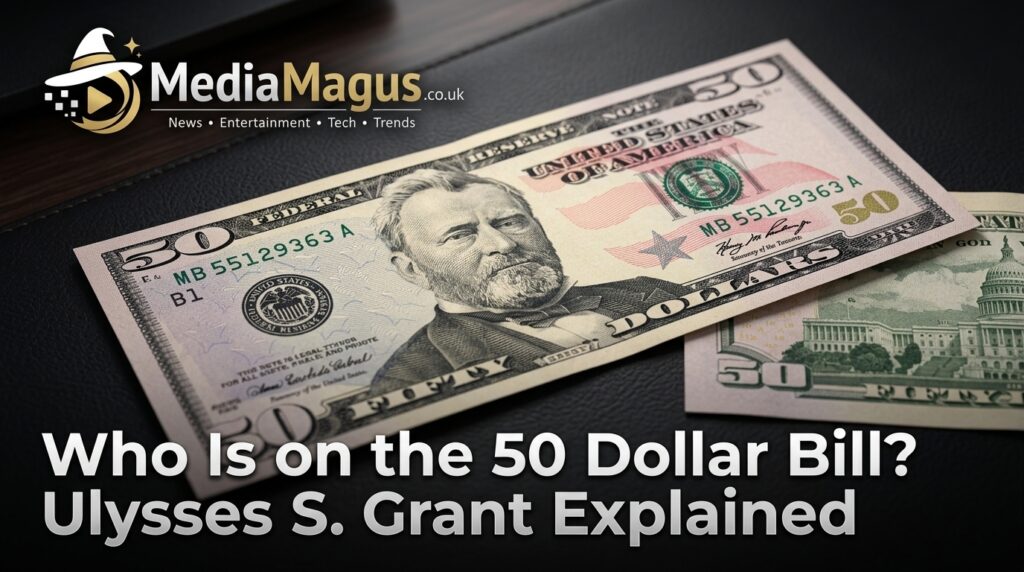

If you have ever looked closely at a United States $50 bill and wondered, Who is on the 50 dollar bill? the answer is Ulysses S. Grant, the 18th president of the United States and one of the most important Union military leaders of the American Civil War. Grant’s portrait appears on the front of the $50 Federal Reserve Note, while the back features the United States Capitol in Washington, D.C. His appearance on American currency reflects his major role in the Union victory during the Civil War and his later service as president during the difficult Reconstruction era. The $50 bill is therefore more than a medium-value piece of paper money; its imagery connects American currency with a major period of national conflict, political change, and reconstruction.
Who Is on the $50 Dollar Bill?
The person on the $50 dollar bill is Ulysses S. Grant. He served as the 18th president of the United States from 1869 to 1877, but he became nationally prominent before becoming president because of his military leadership during the Civil War. Grant eventually became the commanding general of the Union Army and played a central role in defeating the Confederacy. His military success helped establish him as one of the most recognizable national figures of his generation, which later contributed to his selection for the $50 note.
Grant was born on April 27, 1822, in Point Pleasant, Ohio, and grew up in Georgetown, Ohio. He attended the United States Military Academy at West Point and graduated in 1843. Before the Civil War, his military career was relatively uneven, and he spent periods outside active military service. The outbreak of the Civil War changed the direction of his life. Grant returned to military service and quickly demonstrated the determination and strategic leadership that would eventually make him one of the Union’s most important generals.
His portrait on the $50 bill is therefore associated not only with the presidency but also with the preservation of the United States during the Civil War. This is an important distinction because Grant’s historical importance began well before he entered the White House.
Who Was Ulysses S. Grant?
Ulysses S. Grant is best known for his leadership of Union forces during the American Civil War. His military career included several important victories, and his reputation grew as the war continued. One of the most significant moments came in 1862 when Grant captured Fort Donelson in Tennessee, an important Union victory that helped strengthen the Union position in the Western Theater.
Grant later became commander of the Union Army and directed campaigns against Confederate forces under General Robert E. Lee. His strategy placed sustained pressure on Confederate armies and resources. In April 1865, Lee surrendered to Grant at Appomattox Court House in Virginia. Although the surrender did not instantly end every military action associated with the Civil War, it represented a decisive moment in the collapse of the Confederacy.
After the war, Grant remained a major national figure. In 1868, he won the presidential election and took office in March 1869. He served two terms, making his presidency part of the period commonly associated with Reconstruction. His administration faced major challenges involving the rebuilding of the former Confederate states, civil rights, political conflict, and corruption within government.
Grant’s historical reputation has changed considerably over time. Earlier assessments often emphasized corruption scandals associated with people in his administration, while more recent historians have also examined his efforts to protect Black Americans’ civil and voting rights during Reconstruction. This broader historical context helps explain why Grant remains a significant figure in American history.
Why Is Ulysses S. Grant on the $50 Bill?
Grant’s appearance on the $50 bill is closely connected to his importance in American history. As a Union general, he played a decisive role in the military defeat of the Confederacy, and as president, he led the country during the challenging Reconstruction period. His public prominence and historical importance made him a fitting figure for national currency.
The choice of historical figures on American currency has traditionally reflected people considered important to the nation’s political, cultural, or historical development. Grant joins several other U.S. presidents and major American statesmen whose portraits appear on Federal Reserve notes. George Washington is on the $1 bill, Thomas Jefferson is on the $2 bill, Abraham Lincoln is on the $5 bill, Alexander Hamilton is on the $10 bill, Andrew Jackson is on the $20 bill, Grant is on the $50 bill, and Benjamin Franklin appears on the $100 bill.
Grant’s position on the $50 note also creates an interesting connection between American military and political history. He was both a leading Union commander and a two-term president, giving his portrait significance beyond a single period of his life.
What Is on the Back of the $50 Bill?
The back of the $50 bill features the United States Capitol. The building is one of the most recognizable symbols of the federal government and serves as the meeting place of the United States Congress. Its appearance complements Grant’s portrait on the front by connecting an important American leader with one of the country’s most recognizable political institutions.
The Capitol imagery also makes the $50 note visually distinct from other denominations. For example, the back of the $20 bill features the White House, while the $10 bill shows the U.S. Treasury Building. The $5 bill features the Lincoln Memorial, and the $100 bill displays Independence Hall.
This arrangement gives U.S. currency a broader historical theme. The portraits on the front identify important people, while the reverse designs often highlight buildings, monuments, or symbols connected with American history and government.
What Does the Current $50 Bill Look Like?
The modern $50 bill is a Federal Reserve Note with a portrait of Ulysses S. Grant on the front. The current circulating design was issued beginning in 2004, and the Bureau of Engraving and Printing identifies the current $50 note as being issued from 2004 to the present. The note uses subtle background colors and several security features intended to make counterfeiting more difficult.
The front includes Grant’s portrait, the denomination numerals, the Federal Reserve and Treasury-related markings, and other design elements used to identify the note. The reverse displays the U.S. Capitol along with large denomination markings.
One notable feature of modern U.S. currency is that its design is not based simply on color. The Federal Reserve and Bureau of Engraving and Printing have incorporated security elements that can be checked through touch, observation, and movement. This makes the $50 bill different from ordinary printed paper because its materials and design are specifically engineered for durability and authentication.
Security Features on the $50 Bill
Modern $50 bills contain several security features that help the public and businesses determine whether a note is genuine. These features are especially important because counterfeiters have access to increasingly sophisticated digital printing and imaging technology.
One important feature is the watermark. When a genuine $50 note is held up to a light source, a faint image associated with the portrait can be seen from either side of the note. The security thread is another important feature. It is embedded vertically in the paper and contains denomination-related markings that can be observed when the bill is held toward light.
The $50 bill also uses color-shifting ink. The large numeral representing the denomination on the lower-right portion of the front changes appearance when the note is tilted. This provides a simple authentication check that does not require special equipment.
People should not rely on a single feature when checking currency. Examining several security elements together provides a better way to identify suspicious notes. The color and overall appearance of a bill can be useful visual clues, but security features such as the watermark, security thread, and color-shifting ink are more meaningful authentication elements.
History of the $50 Dollar Bill
The $50 denomination has a long history in the United States, extending well beyond the modern Federal Reserve Note. The Bureau of Engraving and Printing lists $50 notes from several design periods, including versions issued from 1914 to 1990, 1990 to 1997, 1997 to 2004, and the current design issued from 2004 onward.
This history shows that American paper money has changed considerably over time. Currency designs have been updated to improve security, standardize appearance, and make denominations easier to distinguish. The modern $50 note introduced subtle background colors and additional security elements as part of the government’s efforts to combat counterfeiting.
The 2004 redesign was particularly important because it introduced enhanced features such as a watermark, security thread, color-shifting ink, subtle blue and red background colors, and other design elements. The redesigned $50 note began circulating in September 2004.
Older $50 bills should not automatically be considered invalid simply because their appearance differs from today’s version. U.S. currency remains legal tender regardless of when it was issued, although older notes may have different designs and security features.
Is the $50 Bill Still in Circulation?
Yes, the $50 bill remains a denomination of U.S. currency and is still used in circulation. The Bureau of Engraving and Printing currently lists the $50 note as a circulating denomination, and the Federal Reserve continues to account for $50 notes in its currency operations.
The denomination is less commonly seen in everyday transactions than $1, $5, $10, $20, and $100 notes in many situations, but it remains completely valid for payments. A genuine $50 Federal Reserve Note has a face value of $50 regardless of whether it is new or has been in circulation for years.
There is also an important difference between a bill being valid and a bill being newly printed. The Federal Reserve determines currency demand and places production orders with the Bureau of Engraving and Printing. The quantity of each denomination produced can therefore change from year to year depending on demand and existing currency inventories.
$50 Bill vs. Other U.S. Bills
The $50 bill occupies an interesting position among commonly circulating U.S. denominations. It is higher in value than the $20 note but lower than the $100 note. Its portrait of Grant also makes it different from several other bills because it features a president who is particularly associated with Civil War military leadership.
| U.S. Bill | Person on Front | Main Image on Back |
|---|---|---|
| $1 | George Washington | Great Seal |
| $2 | Thomas Jefferson | Declaration of Independence |
| $5 | Abraham Lincoln | Lincoln Memorial |
| $10 | Alexander Hamilton | U.S. Treasury Building |
| $20 | Andrew Jackson | White House |
| $50 | Ulysses S. Grant | U.S. Capitol |
| $100 | Benjamin Franklin | Independence Hall |
This comparison also explains why people searching for “who is on the 50 dollar bill” may initially recognize Grant without remembering his name. The faces on U.S. currency are familiar to millions of people, but the historical stories behind them are often less familiar.
Conclusion
The answer to who is on the 50 dollar bill? is Ulysses S. Grant, the 18th president of the United States and one of the most important Union commanders of the Civil War. His portrait represents a major figure in the country’s struggle to preserve the Union, while the United States Capitol on the reverse connects the note with America’s federal government. The modern $50 bill also combines historical imagery with sophisticated security features, including a watermark, security thread, and color-shifting ink. Understanding the person behind the portrait makes the $50 note more than simply a piece of currency it becomes a small representation of a significant chapter in American history
You may also read more blogs
Who Is Better Messi and Ronaldo?
Frequently Asked Questions About the $50 Bill
Who is on the 50 dollar bill?
Ulysses S. Grant is on the $50 dollar bill. He was the 18th president of the United States and a leading Union general during the American Civil War.
Was Ulysses S. Grant a president?
Yes. Ulysses S. Grant served as the 18th president of the United States from 1869 to 1877. Before becoming president, he became nationally famous for his leadership of Union forces during the Civil War.
What is on the back of the $50 bill?
The back of the $50 bill features the United States Capitol in Washington, D.C. The Capitol is the home of the U.S. Congress and is one of the most recognizable symbols of the federal government.
Why is Grant on the $50 bill?
Grant appears on the $50 bill because of his major historical importance as a Union military leader and as the 18th president of the United States. His role in the Civil War made him one of the most prominent American figures of the 19th century.
Is the old $50 bill still valid?
Yes. Genuine U.S. currency remains legal tender regardless of when it was issued. Older $50 notes may have different designs and security features, but their age alone does not make them invalid.
When was the current $50 bill introduced?
The current $50 design was issued beginning in 2004. It introduced updated security features and subtle background colors designed to make the note more difficult to counterfeit.
Is Ulysses S. Grant on any other U.S. bill?
Grant is best known on the $50 Federal Reserve Note. The current circulating U.S. denominations feature different historical figures, with Grant specifically associated with the $50 note.
Is the $50 bill still being produced?
The Federal Reserve continues to include the $50 denomination in its currency planning and print orders when needed. Production levels can vary according to demand, currency inventories, and other operational factors.