
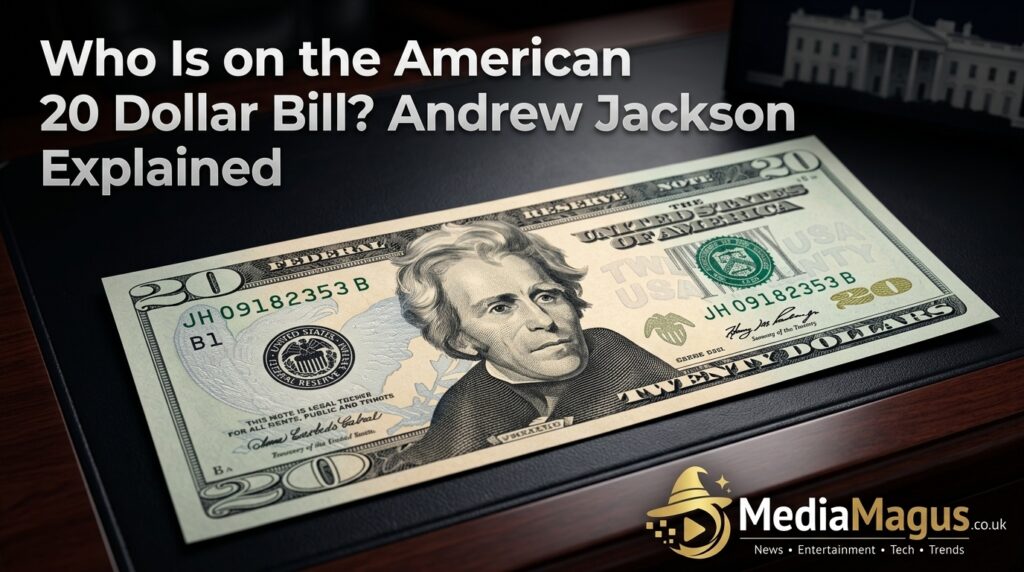

who is on the american 20 dollar bill: The person on the American $20 bill is Andrew Jackson, the seventh president of the United States. His portrait appears on the front of the current $20 Federal Reserve note, while the White House is shown on the back. The U.S. Currency Education Program identifies Andrew Jackson as the president featured on the current $20 note, which first entered circulation in its current design on October 9, 2003.
Andrew Jackson served as president from 1829 to 1837 and remains one of the most recognizable and controversial figures in American history. His appearance on the $20 bill reflects his historical importance in the development of the United States during the early nineteenth century, although his legacy is also debated because of his policies toward Native Americans, his role in Indian Removal, and other aspects of his presidency. The $20 bill therefore represents more than just a familiar portrait on American currency; it connects everyday money with a complicated period of U.S. history.
The current $20 note also contains several security features designed to make counterfeiting more difficult. These include an embedded security thread, a portrait watermark of Andrew Jackson, color shifting ink, microprinting, and raised printing.
Who Was Andrew Jackson?
Andrew Jackson was born on March 15, 1767, in the Waxhaws region, an area associated historically with the border between North and South Carolina. He became a military commander, politician, and ultimately the seventh president of the United States. His public career helped shape American politics during a period when political participation was expanding among white male voters and political parties were becoming increasingly organized.
Jackson first became nationally famous for his military career. His reputation grew significantly during the War of 1812, particularly after the Battle of New Orleans in January 1815. His military success made him a national hero and helped establish the public image that eventually supported his presidential campaigns.
As president, Jackson promoted what became known as Jacksonian democracy. He presented himself as a representative of ordinary white voters and challenged established political institutions and elites. His presidency also included major controversies, including the destruction of the Second Bank of the United States and his administration’s policy of Indian removal.
His historical reputation is therefore complex. Some historians emphasize his influence on American political participation, executive power, and the development of the Democratic Party. Others focus heavily on the devastating consequences of Indian Removal and the forced relocation of Native American communities. Understanding both sides is important when explaining why Jackson appears on a major American banknote.
Why Is Andrew Jackson on the $20 Bill?
Andrew Jackson appears on the $20 bill because he was a major figure in American political and military history. His presidency was a significant turning point in the development of the nation’s political system, and his public reputation remained influential long after his death.
The use of historical figures on U.S. currency is not limited to presidents. For example, Alexander Hamilton appears on the $10 bill, Benjamin Franklin appears on the $100 bill, and Ulysses S. Grant appears on the $50 bill. The $20 bill is therefore part of a broader American tradition of placing historically significant people on Federal Reserve notes.
Jackson’s connection to the $20 denomination also goes back many decades. According to the U.S. Currency Education Program, the portrait on the $20 note was changed in 1929 to feature Andrew Jackson, while the back was changed to feature the White House.
That means Jackson has been associated with the $20 bill for nearly a century. Although the design has been modified several times to improve security and appearance, his portrait has remained a recognizable feature of the denomination.
What Is on the Back of the $20 Bill?
The White House appears on the back of the current American $20 bill. The image represents one of the most recognizable buildings in the United States and connects the note to the country’s presidential history. The U.S. Currency Education Program specifically identifies the White House as the reverse image of the $20 note.
The pairing of Andrew Jackson on the front and the White House on the back creates a clear connection between the person featured on the note and the institution of the U.S. presidency. Jackson lived in the White House during his two presidential terms, making the reverse image especially relevant to the historical theme of the denomination.
The current design also contains subtle background colors and eagle imagery. The redesigned $20 note introduced green, peach, and blue background elements, along with additional security and design features intended to make the note easier to authenticate and harder to counterfeit.
When Did Andrew Jackson First Appear on the $20 Bill?
Andrew Jackson’s appearance on the $20 Federal Reserve note dates to the 1929 standardization of U.S. currency design. Before that change, the $20 Federal Reserve note had a different portrait. The U.S. Currency Education Program explains that the first $20 Federal Reserve note was issued in 1914 with a portrait of President Grover Cleveland and a Transportation vignette on the back. In 1929, the portrait changed to Andrew Jackson and the reverse changed to the White House.
This history is important because it shows that Jackson was not always the person on the $20 bill. His portrait became associated with the denomination after the government standardized the size and basic design of U.S. currency.
The $20 note has subsequently undergone several redesigns. A major currency redesign began in the 1990s, introducing improved anti counterfeiting features. The modern $20 design was introduced in 2003 with subtle background colors, an embedded security thread, a Jackson watermark, and color shifting ink.
What Security Features Are on the $20 Bill?
The current $20 bill contains several security features that can help people distinguish genuine currency from counterfeit notes. The most useful features can be checked without specialized equipment.
One of the easiest features to check is the security thread. When the $20 note is held up to light, an embedded thread can be seen running vertically to the left of Jackson’s portrait. The thread contains the words “USA TWENTY” and a small flag in an alternating pattern, and it glows green under ultraviolet light.
The bill also contains a portrait watermark. When held up to light, a faint image of Andrew Jackson can be seen in the blank area to the right of the main portrait. The watermark is visible from both sides of the note.
Another feature is the color shifting numeral 20. When the note is tilted, the numeral in the lower right area of the front changes from copper to green. The note also contains raised printing and microprinting that provide additional security characteristics.
These features are useful because the U.S. government periodically redesigns currency primarily to stay ahead of increasingly sophisticated counterfeiting threats.
Is Andrew Jackson Being Removed From the $20 Bill?
This is where the answer requires some historical and current context. In 2016, the U.S. Treasury announced plans for a future $20 note that would feature Harriet Tubman on the front. The proposal was part of a broader planned redesign of the $5, $10, and $20 notes. Treasury Secretary Jacob Lew announced that Tubman’s portrait would appear on the front of the redesigned $20, while Andrew Jackson would appear on the reverse alongside the White House.
However, that proposed design is not the current $20 bill in circulation. The U.S. Currency Education Program continues to identify Andrew Jackson as the person on the current $20 note.
There is also an important distinction between a proposed redesign and an issued banknote. The Bureau of Engraving and Printing explains that currency redesigns are driven primarily by security requirements, and the current planned sequence lists the $10 note first, followed by the $50 and then the $20 note. The Bureau’s current information gives an approximate 2030 timeframe for the $20 redesign, subject to developments in counterfeiting threats and technology.
Therefore, anyone asking who is on the American 20 dollar bill? today should still be given the straightforward answer: Andrew Jackson.
Andrew Jackson vs. Harriet Tubman on the $20 Bill
The discussion surrounding the future $20 bill is important because it represents a broader debate about which people and events should be represented on American currency.
| Feature | Current $20 Bill | Proposed Future Design |
|---|---|---|
| Front portrait | Andrew Jackson | Harriet Tubman was proposed |
| Reverse | White House | White House and Andrew Jackson were proposed |
| Current circulation | Yes | No |
| Modern design introduced | 2003 | Future redesign |
| Main purpose of redesign | Security and usability | Subject to future currency redesign process |
The 2016 Treasury announcement described Harriet Tubman as the person who would appear on the front of the redesigned $20 note, while Jackson and the White House were planned for the reverse.
This distinction matters because internet discussions sometimes incorrectly suggest that Harriet Tubman’s $20 bill has already replaced Andrew Jackson’s. It has not. Current official U.S. currency resources still identify Jackson as the portrait on the $20 note, while the Bureau of Engraving and Printing currently places the $20 redesign later in the planned redesign sequence.
Is the Old $20 Bill Still Legal Tender?
Yes. Older U.S. currency remains legal tender regardless of when it was issued. The U.S. Currency Education Program states that all U.S. currency remains legal tender, and this policy applies to Federal Reserve notes from earlier designs as well as current notes.
This means people do not normally need to exchange an older $20 bill simply because its design looks different from the current version. Older notes may lack some of the security features found on newer designs, but they can still retain their face value as legal U.S. currency.
For collectors, older $20 notes may have additional historical interest depending on their age, condition, rarity, serial number, printing characteristics, and other factors. However, being old does not automatically mean that a $20 bill is worth substantially more than its face value.
How the $20 Bill Fits Into American Currency
The $20 note is one of seven denominations currently issued by the Federal Reserve: $1, $2, $5, $10, $20, $50, and $100. Each denomination has its own portrait and reverse imagery. George Washington appears on the $1, Thomas Jefferson on the $2, Abraham Lincoln on the $5, Alexander Hamilton on the $10, Andrew Jackson on the $20, Ulysses S. Grant on the $50, and Benjamin Franklin on the $100.
This makes the $20 bill particularly recognizable because it combines the portrait of a former president with an image of the White House. Its design has also evolved considerably over time, with modern notes incorporating more sophisticated security technology.
For readers interested in other American currency personalities, related articles about who is on the $50 bill and who is on the $100 bill can naturally expand the topic into a broader U.S. currency history series.
Conclusion
So, who is on the American 20 dollar bill? The answer is Andrew Jackson, the seventh president of the United States. His portrait has appeared on the $20 Federal Reserve note since the major standardization of U.S. currency design in 1929, while the White House has been featured on the reverse. The modern $20 note introduced in 2003 added several security features, including a security thread, Jackson watermark, color shifting numeral, microprinting, and raised printing.
The story becomes more interesting when the proposed future redesign is considered. Treasury announced in 2016 that Harriet Tubman was planned for the front of a redesigned $20 bill, but that design has not replaced the current Jackson note. Current government information identifies the $20 as a later stage in the planned currency redesign sequence, with an approximate 2030 timeframe.
For now, if you look at an American $20 bill in your wallet, you will find Andrew Jackson on the front and the White House on the back. That simple design connects a commonly used piece of currency with nearly a century of American monetary and political history.
You may also read more blogs
Who Is on the $50 Dollar Bill?
Frequently Asked Questions
Who is currently on the American $20 bill?
Andrew Jackson, the seventh president of the United States, is currently featured on the front of the American $20 bill. The back of the note features the White House. The current design entered circulation on October 9, 2003.
Was Andrew Jackson always on the $20 bill?
No. The first $20 Federal Reserve note issued in 1914 featured President Grover Cleveland. Andrew Jackson replaced Cleveland as the portrait on the $20 note when U.S. currency designs were standardized in 1929.
Is Harriet Tubman on the $20 bill now?
No. Harriet Tubman is not on the current $20 bill. In 2016, the Treasury announced a plan to feature Tubman on the front of a future redesigned $20 note, but the current circulating $20 note still features Andrew Jackson.
What is on the back of the $20 bill?
The White House is pictured on the back of the current $20 bill. The building connects the note’s design to the U.S. presidency and American political history.
When was the current $20 bill introduced?
The current-design $20 note entered circulation on October 9, 2003. It introduced subtle background colors and security features including a security thread, Jackson watermark, and color-shifting numeral 20.
Why is Andrew Jackson controversial?
Jackson is controversial because his presidency included policies and actions with serious consequences for Native American communities, particularly Indian Removal. At the same time, historians recognize his importance in the development of American electoral politics, presidential power, and the Democratic Party. His legacy is therefore both historically significant and deeply debated.
Will Andrew Jackson eventually be removed from the $20 bill?
The Bureau of Engraving and Printing currently lists the $20 note for a planned redesign around 2030, subject to changes in security needs and technology. A 2016 Treasury proposal called for Harriet Tubman to appear on the front of a future $20 note, but no such note currently circulates.
Are old $20 bills still valid?
Yes. U.S. currency remains legal tender regardless of when it was issued. An older $20 bill does not automatically become invalid simply because a newer design is circulating.